

ESTP video conference – March 17, 2021 © SB and ZG, Paris
The following article is the report on the video conference held on March 16, 2021 by Sylvie Buisson for the ESTP Leaders’ Club [alumni of the École Spéciale des Travaux Publics]. It is signed by Mrs Zélie Gauthier – Head of the Maintenance and General Resources Department (S2MG), Directorate of Real Estate and General Services, and will be included in the journal Ingénieur Constructeur, to be published shortly.
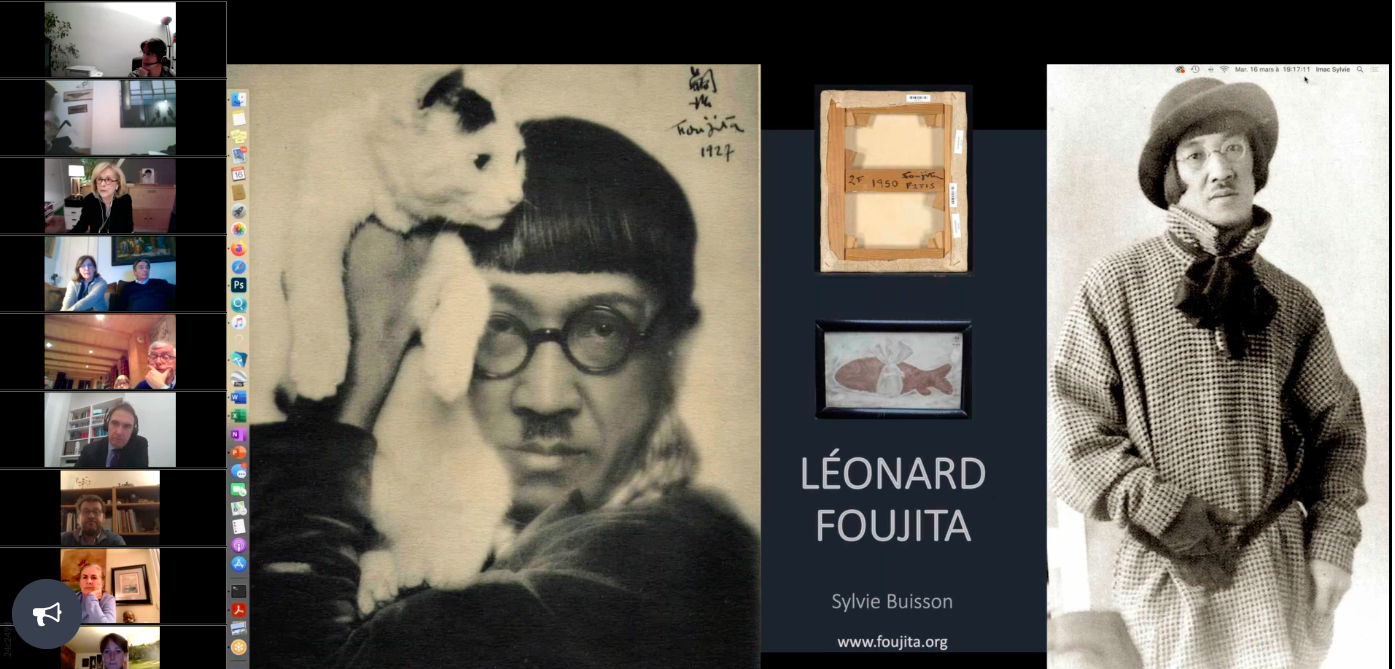 From his childhood in Japan to his conversion to Catholicism in Reims, via the euphoria of the Roaring Twenties in Montparnasse: yet always with recurring themes—his love of Art, of life, of himself, and of women in particular. Born in 1886, having lost his mother at the age of 5, this runaway child, later transgressive, lived on the margins within his aristocratic family. He recreated a world around himself, notably through art. After studying at the Tokyo School of Fine Arts, he left for Paris in 1913. He made his name pronounceable for the French: Tsuguharu Fujita thus became Léonard Foujita. With no master, no pupil, no code, he was very different from the other painters of the time and, after trying Cubism and other styles of his friends, he created his own style inspired by both Japan and France.
A star among stars, this dandy—friend of Modigliani, Picasso, Matisse, Vlaminck, Soutine, and others—devoured parties, travel (he would circle the globe four times) and women as much as work. A jack-of-all-trades, he was as much a painter as a sculptor, fashion designer, photographer… and, with his friends, he revolutionised painting worldwide. A subversive figure, he lived to be noticed, using his look. Long before Andy Warhol, he staged himself to catch journalists’ eyes. “Only the power of art can transcend borders and racial barriers to reach the hearts of men. In the friendship between two countries, the most useful exchange is that of artists.”
The author of a dazzling and highly personal Japonisme, at the crossroads of East and West, he revealed his aesthetic choices and virtuosity in Paris, which opened the doors to international fame. Japan left him with a synthetic, pure, pared-back side (emptiness is as important as fullness; this is the philosophy of “Ma”: the importance of space, even though everything is nonetheless connected), while Paris offered him freedom of expression.
Foujita’s line reveals unfailing certainty, and his strokes a calligraphic finesse. His signature also comes from a blend of techniques he invented: a white ground on which he could lay down either a very fine black line or oil paint. He made his own medium and achieved that particular white thanks to an emulsion of crushed oyster shells mixed with a binder (a technique discovered recently through scientific analyses).
White, black and gold are his favourite colours. The cat (a mythical animal in Japan through which he projects himself) and the woman (surely due to the trauma of losing his mother) would be his preferred models. This black-and-white contrast is inspired by the TAO: two forces that drive and follow one another to connect with the great energy of the cosmos. This “Tao” movement (Yin and Yang) is often found in his paintings. Lastly, in order to maintain a link with his ancestors, he also plays with the philosophy of “Wabi Sabi”, which consists of a blend of the old and the modern. He draws inspiration from works or techniques, French or Japanese, but also inserts “aged” objects into his works.
Seven women accompanied his life. For him, woman is elevated to the rank of mother of the universe. First his mother, then his Japanese fiancée, whom he had to leave because the war prevented them from reuniting. Fernande Barrey, the garçonne, was his 1st French wife in 1917. Then came Youki, then Madeleine (his favourite model, with whom he travelled a great deal), and finally Kimiyo (a young Japanese woman he met during his forced return to Japan as a painter shortly before the 2nd World War). The 6th woman who mattered in his life, while remaining his friend, was Kiki de Montparnasse, the famous model, and the 7th, the Virgin Mary, who accompanied him from childhood (an intriguing statue at the Étoile du Matin school in Japan, where he learned French while still in secondary school) in his mystical reflection.
Towards the end of his life, he regained his freedom. Ruined after the war, he returned to France and, within six months, through the sale of his works, he was able to resume his life as an artist without constraints—Modernity, and also the Mystical… Indeed, he converted to Catholicism in 1959 and even went so far as to create and decorate a chapel dedicated to Our Lady of Peace in Reims in 1966. A heavy smoker, he died in early 1968 of cancer, but left an important body of work of nearly 10,000 pieces.
A very rich life, therefore, retraced with passion in one hour: what a challenge!