Nadine TARBOURIECH
VISWANADHAN, HIS PICTORIAL, CINEMATOGRAPHIC AND LITERARY WORK
Return to Experts
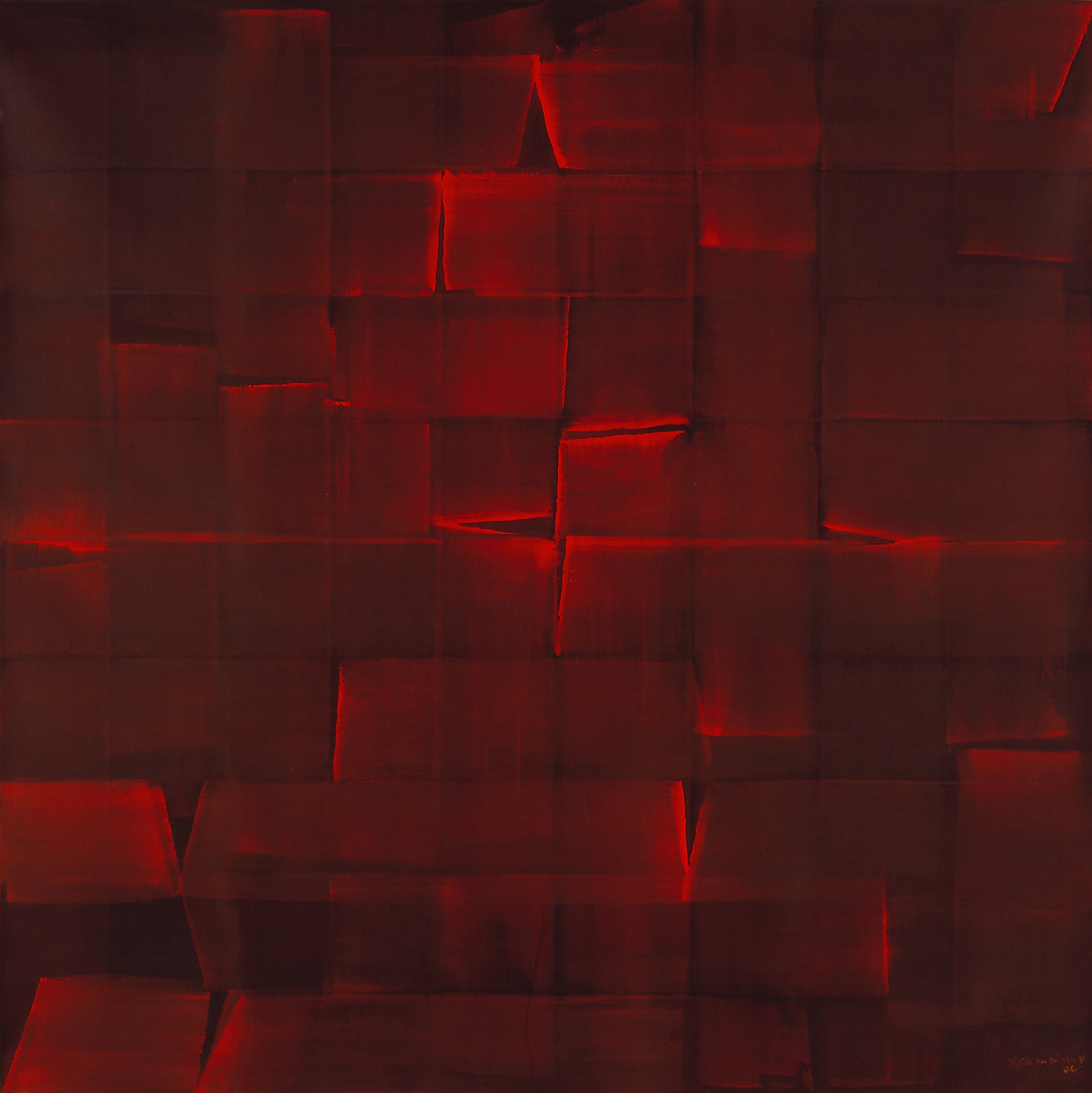
VISWANADHAN - Untitled 2006 - Casein on canvas, 210 x 210 cm - © photo Béatrice Hatala / © Viswanadhan archives, Paris
The expert:
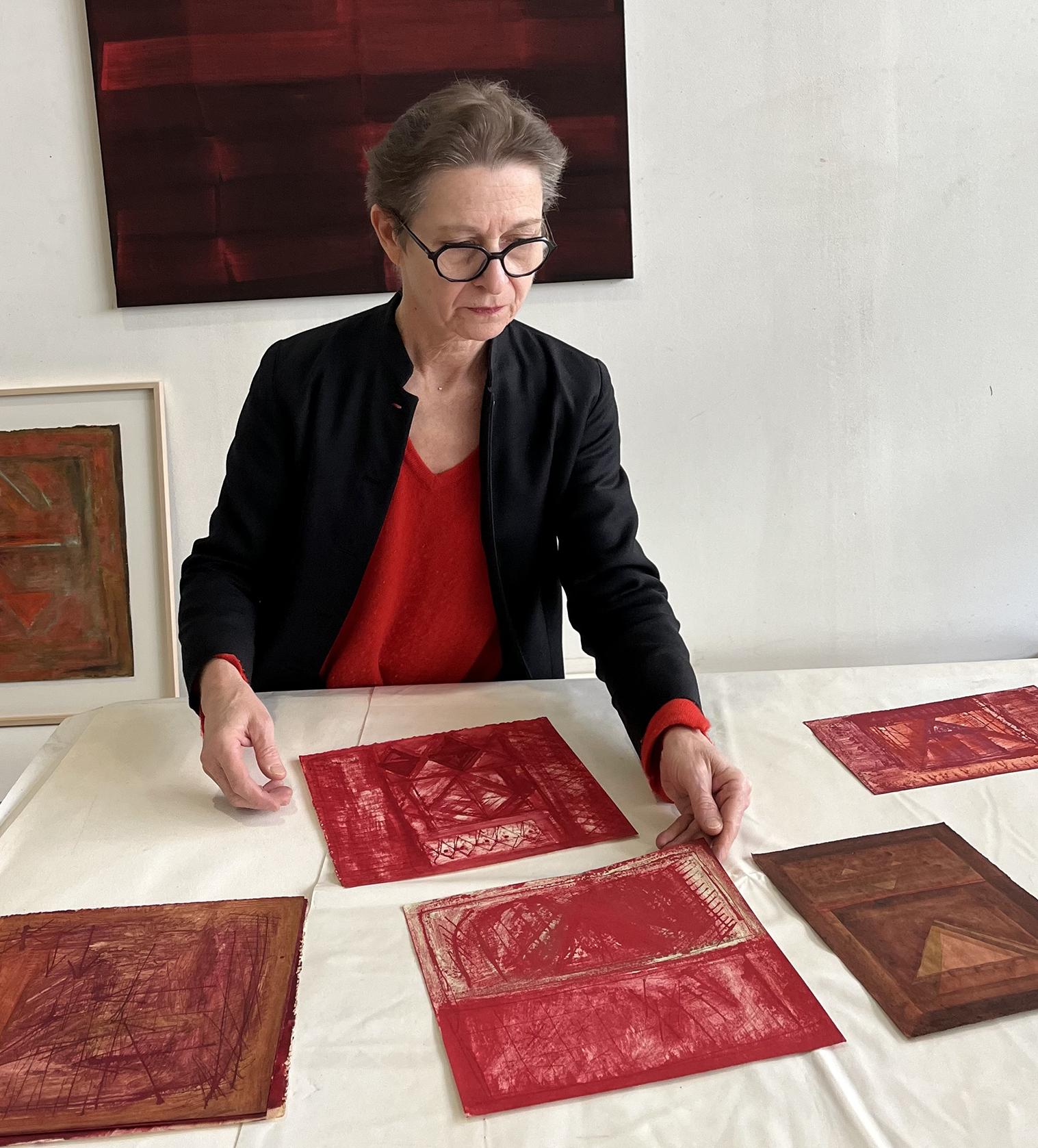
Nadine Tarbouriech is the editor of the Catalogue Raisonné of Viswanadhan's Work, currently in preparation, in the categories VISWANADHAN - Painting, Cinema, Photography and Literature. She met the artist in 2001 thanks to Adoor Gopalakrishnan, a renowned Indian filmmaker and director of photography on Viswanadhan's films between 1976 and 1985. Trained from a young age in drawing and painting by the artist Pierre Raffi, she then turned to cinema. As a chief editor, at 24, she designed the soundtrack for Philippe Le Guay's film Les Deux Fragonard, edited films by critics from Cahiers du Cinéma (Hervé Le Roux, Jean-Pierre Limosin, etc.) as well as several feature films and documentaries, notably for the Réunion des Musées Nationaux. Actively involved in the world of cinema, she co-directed editing workshops with Alain Bergala, participated in aid allocation committees for the Centre National du Cinéma, and served as a juror in international festivals. In 2000, she went to India as a correspondent for the Cannes Film Festival, and also on a mission from the Ministry of Foreign Affairs for a report on Indian cinema. In 2003, she curated a retrospective of Indian cinema at the Centre Pompidou. Gradually, she returned to her first passion, painting, and dedicated herself fully to her studio. It was during this period that her connection with Viswanadhan's work deepened. Involved in the administrative and logistical aspects of his studios in Paris and Chennai (India), she became a privileged observer of his work, freely assisting in his creative processes. She even listened to him read texts he had just written for a Kerala newspaper, where he regularly published. Viswanadhan also shared his expertise with her by initiating her into the casein technique, which he had practiced since 1982, enabling her today to master the restoration of his works. Since 2006, she has been responsible for organizing exhibitions, managing relationships with institutions, collectors, and galleries, as well as monitoring the commercialization of works at auction, ensuring their authenticity and provenance. With a significant archive, she continues to enrich her documentation through new testimonies and documents, thus deepening her knowledge of the different periods of Viswanadhan's Work. [caption id="attachment_4228" align="alignleft" width="2560"]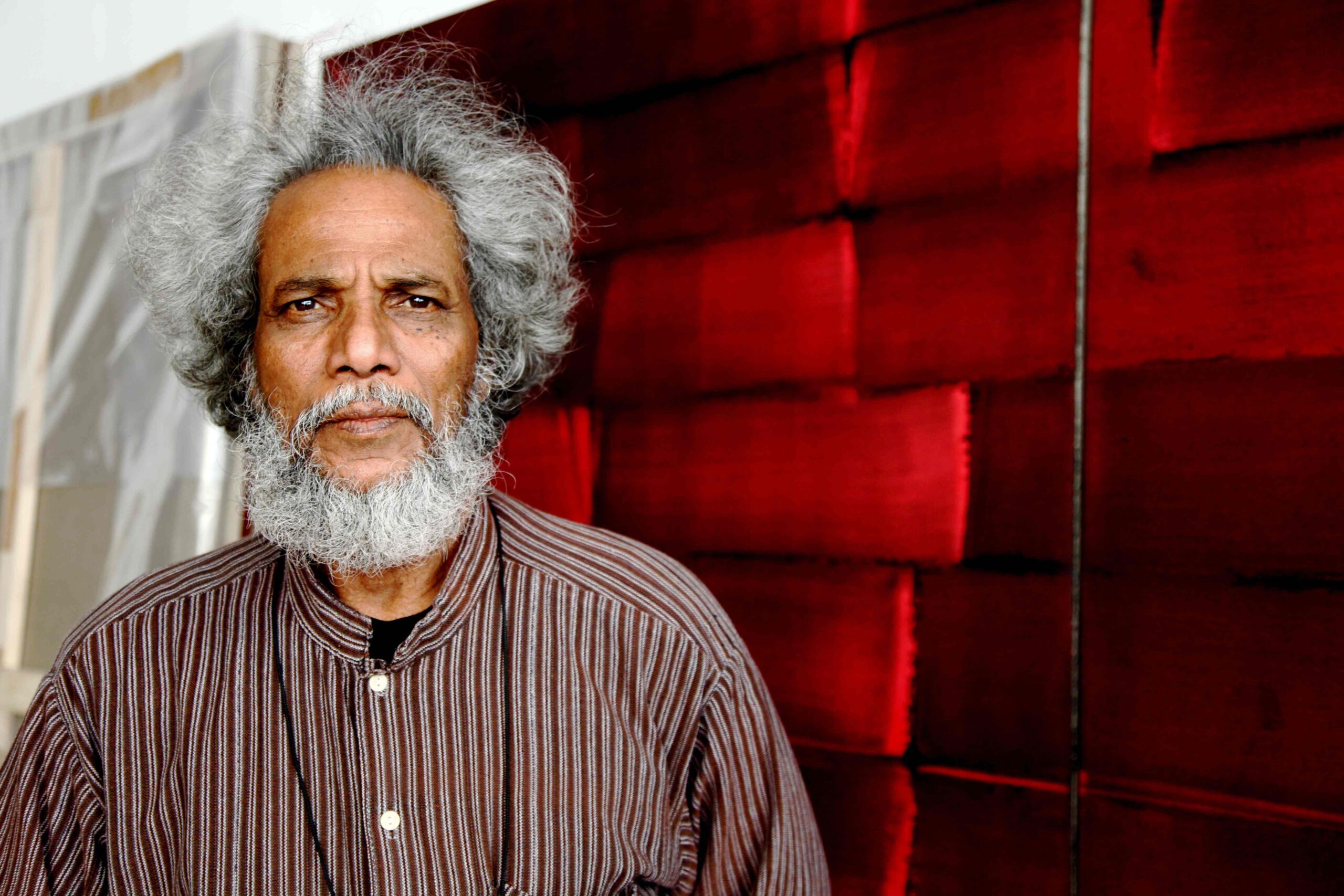 Portrait of Viswanadhan in his Ivry-sur-Seine studio - 2011 © photo Didier Gicquel / © Viswanadhan archives, Paris.[/caption]
The artist:
Born in 1940 in the state of Kerala, southwest India, Viswanadhan studied at the College of Arts and Craft in Madras. In 1966, alongside his professor and school director, K.C.S. Paniker, he founded the Cholamandal Artists’ Village, an artists' community located on the south coast of Madras. The following year, in 1967, his works were presented for the first time in France at the Paris Biennale. In 1968, he moved to Paris and joined the Galerie de France, which organized his first solo exhibition in 1970. The following year, he won the Golden Palette at the Cagnes-sur-Mer Painting Festival. From 1980 to 2007, he was represented by the Darthea Speyer gallery in Paris as well as by several galleries in India. In 1998, a major retrospective of his work was organized in the national museums of New Delhi, Mumbai, Kolkata, and Chennai. His influence extends beyond painting. In 2002, the Manufacture des Gobelins created a tapestry based on one of his works. In 2008, the Marlborough Gallery in New York dedicated a retrospective to his work. In 2025, an entire pavilion will be dedicated to him at the Sharjah Biennial 16 (SB16), highlighting the depth and uniqueness of his work within international contemporary art. Viswanadhan is also a filmmaker. He directed his film series titled “The Five Elements” (Sand, Water/Ganga, Agni/Fire, Air/Vayù, Ether/Aakash) preserved in the collections of the Centre Pompidou, and awarded numerous festival prizes. Furthermore, his writings, penned in his native language, Malayalam*, are published as a collection in India. Today, he is represented by the Nathalie Obadia gallery (Paris-Brussels), and his works are featured in numerous public collections in France and internationally.A Work between tradition and spirituality:
Hailing from the Vishwakarmas caste, which includes traditional architects, painters, and sculptors associated with temples, Viswanadhan was initiated from a young age by his father into the art of idol sculpture and the creation of mandalas or kalamezhuthus, ritual diagrams drawn on the ground in Hindu and Tantric ceremonies. His artistic work draws from these childhood reminiscences, revisiting geometry and color while cultivating a profound architectural sense. Over six decades of artistic practice, enriched by a cinematographic journey in search of the immemorial places, traditions, and gestures of his native country, shape his aesthetic. His work progressively evolves towards plays of transparency and light, where evanescent lines give way to a purity imbued with spirituality. His palette gradually concentrates around red and black, giving rise to an artistic expression of rare intensity. * A Dravidian language, Malayalam is the official language of the state of Kerala and one of India's 22 official languages.Bibliography
Viswanadhan, catalogue, galerie Nathalie Obadia (Paris-Brussels), 2025 Viswanadhan, catalogue, Marlborough Gallery New York, 2008 Viswanandhan early years, Delhi Art Gallery, New Delhi, India 2007
Contact
Nadine TARBOURIECH
13 rue Ricaut
75013 Paris
+ 33 (0)6 08 69 13 26
nadineviswanadhan@gmail.com
[UFE number : 513 ]