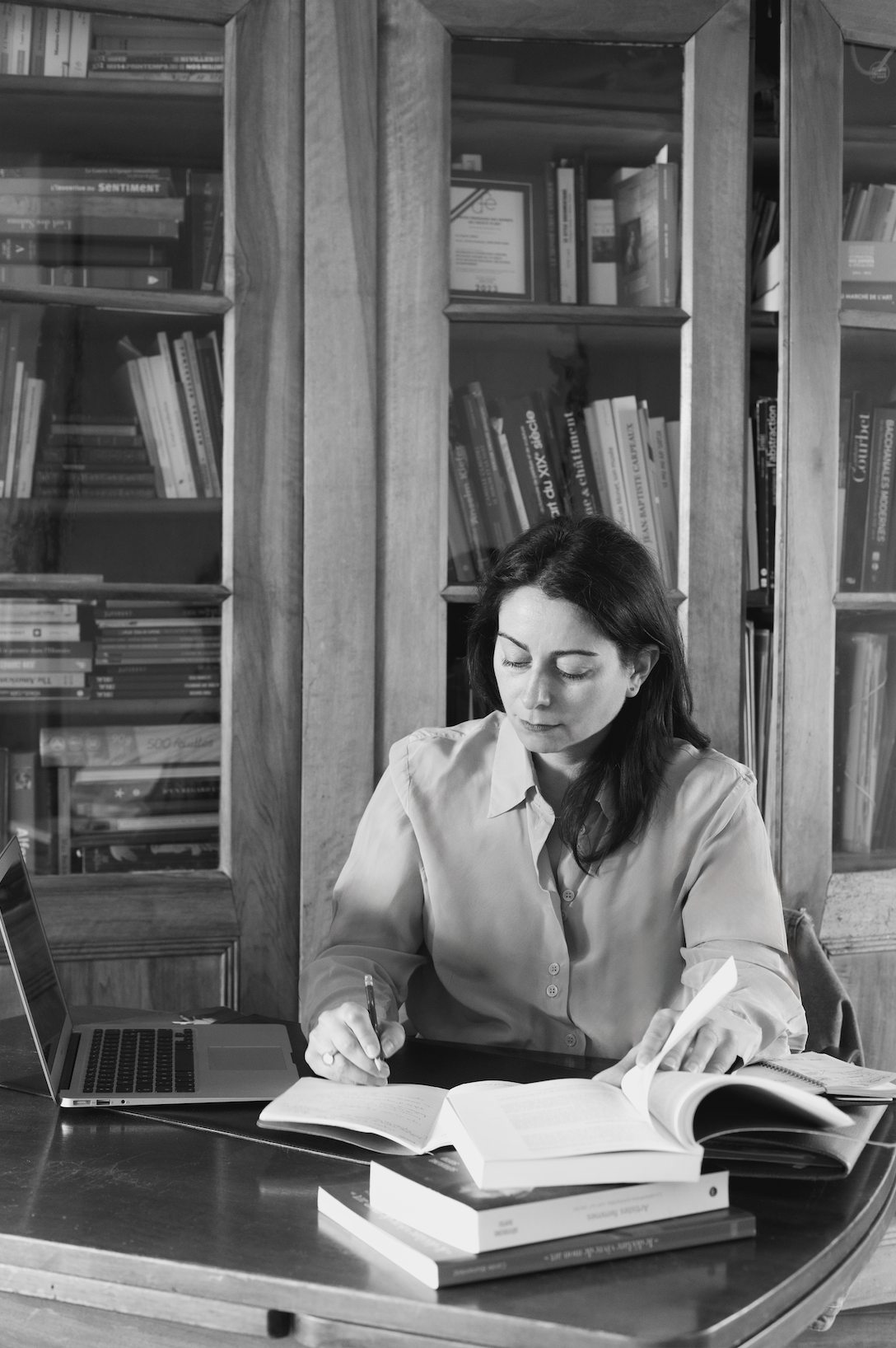
Agathe CABAU
RESEARCH AND ATTRIBUTION OF WORKS FROM OFFICIAL 19TH-CENTURY SALONS AND THE PAINTER JULIE HUGO, NÉE DUVIDAL DE MONTFERRIER
Return to Experts
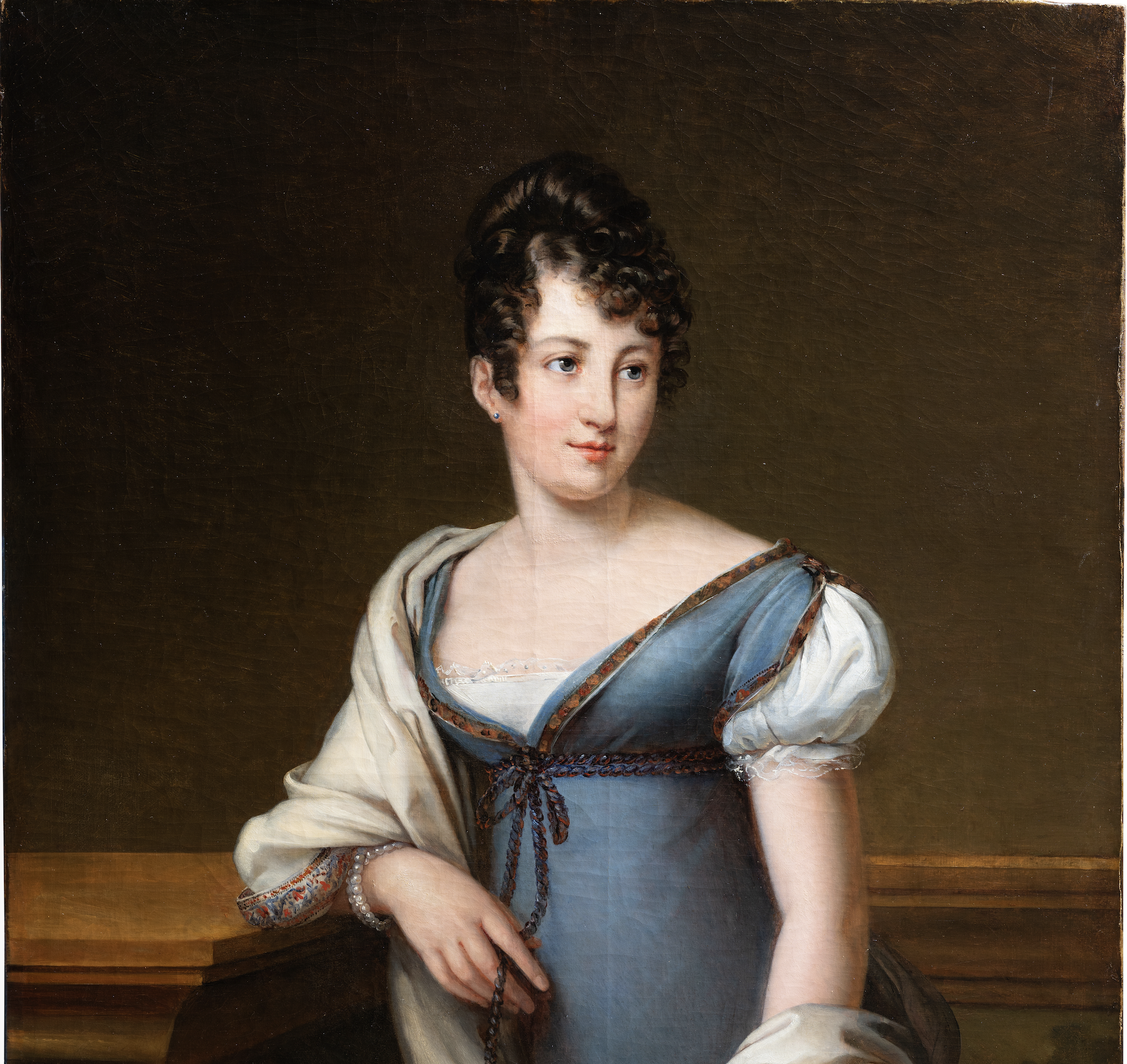
(detail) - Julie Duvidal de Montferrier, Countess Abel Hugo (1797-1865), Portrait of Marie-Constance-Albertine Moisson de Vaux, Baroness of Montaran, c. 1817, oil on canvas, 109.6 x 82.4 cm, private coll. expert archives, © Inu studio
The Expert
Agathe Cabau is an expert in documentary research and the attribution of works formerly exhibited in the 19th-century Fine Arts Salons (XIXe). She works for art dealers, French museums, and collectors to document the provenance and traceability of 19th-century paintings; she diagnoses the conservation status of paintings, authenticates them, and attributes them. Her documentary and iconographic research, as well as the drafting of her catalogue entries in both French and English, are invaluable. Her investigations conducted within archival collections and her expertise in painting allow her to identify the author of a work and/or reconstruct an artist's career. Some of the paintings she has appraised have since entered public collections, such as Henry Caro-Delvaille's The White Peacock at the Musée Basque et de l'histoire de Bayonne, or Julie Duvidal de Montferrier's Portrait of Marie-Constance-Albertine Moisson de Vaux, Baroness of Montaran at the Musée des Beaux-Arts de Caen. Agathe Cabau completed training in law and techniques of art expertise at Paris 2 Panthéon-Assas University in 2018, followed by an internship at Cabinet Eric Turquin Expertises in Paris. Agathe Cabau holds a PhD in Art History and has been a graduate of Paris 1 Panthéon-Sorbonne University since 2014. Her academic work involved a significant corpus of works exhibited in the Salons and the Fine Arts sections of the French Universal Exhibitions from 1789 to 1914. To document the works of American artists and trace their history, she was awarded a grant from the Terra Foundation to join the Smithsonian American Art Fellowship Program and conduct research at the Archives of American Art in Washington, D.C. In 2017, she co-curated the exhibition at the Musée du Nouveau Monde in La Rochelle entitled "The Scalp and the Calumet: Imagining and Representing the Indian in the West from the 16th Century to the Present Day," which drew on her doctoral research for the 19th-century section. She has co-edited a scientific journal issue in her specialty (Transatlantica) and conference proceedings in English for the German Center for Art History (Heidelberg University Library). Agathe Cabau served as a lecturer in 19th-century art history at the Université de Paris Est-Marne la Vallée for three years, at the Institut d’Études Supérieures des Arts, and at the CIEE Paris Center for American students. ________________________________________ Her expertise extends particularly to the life and work of the painter Julie Hugo, née Duvidal de Montferrier, sister-in-law of Victor Hugo, whose early work she rediscovered and on whom she is currently preparing a Catalogue Raisonné. Julie Hugo (1797-April 10, 1865), her life, her work, by Agathe Cabau. Louise Rose Julie Duvidal de Montferrier received a privileged education at the establishments of Madame Campan, former reader to Queen Marie-Antoinette. The director of the Maison Impériale Napoléon wished for her students to receive a solid education extending to the fine arts. It was under Madame de Balzac and Elisabeth Swagers (a student of Augustin Pajou and Adélaïde Labille-Guiard) in Écouen that Julie Duvidal learned drawing. It was likely through the mediation of Madame Campan that the young Julie Duvidal entered the studio of the duo formed by Gérard and Marie-Eléonore Godefroid. As early as 1816, her former teacher also introduced her to a wealthy female clientele. From 1817 to 1820, Julie Duvidal painted numerous portraits of the aristocracy and European courts, religious paintings, and Troubadour subjects. One of her works was acquired by King Louis XVIII during her first participation in the Fine Arts Salon of 1819. Julie Duvidal trained young students in a studio on Rue de Seine, notably Adèle Foucher, the future Madame Hugo. Over the years, the ties between the Hugo family and the Duvidal de Montferrier family grew closer. She married Abel Hugo, the eldest of the siblings, on December 20, 1827, at the Church of Saint-Thomas d'Aquin. After gaining recognition at the Salon of 1822, Julie Duvidal left for Brussels in 1823. On the recommendation of the painter Antoine-Jean Gros, she was received by the exiled Neoclassical master Jacques-Louis David, who complimented her painting. In November of the same year, she accompanied Madame Récamier to Rome. Upon her return to France, Julie Duvidal kept her studio on Rue du Cherche-Midi, on the ground floor of the Hôtel des Conseils de Guerre, and exhibited at the Salon of 1824. She achieved success, being awarded a gold medal. She traveled to England in 1830-31 and continued to exhibit in Paris until 1833, and in Lille the following year. From then on, she received numerous commissions for paintings and specialized in copying works, which continued until the end of her life. The young woman left a strong impression on her fellow artists and acquaintances. Today, her works can be seen in Washington D.C. (National Museum of Women in the Arts), in Taiwan (Chimei Museum), and in France at the National Assembly, the École Supérieure des Beaux-Arts de Paris, the Musée de l'Armée, the Musée de la Vie Romantique, the Musée Antoine Vivenel in Compiègne, the Musée de Picardie in Amiens, the Musée des Beaux-Arts de Louhans-Châteaurenaud, the Palace of Versailles, the Musée du Monastère Royal de Brou, the Musée Fabre in Montpellier, and the Maisons Victor Hugo in Paris and Guernsey.Bibliography
Co-edited Publications
- Emily Burns & Agathe Cabau (eds.), "Dialoguing the American West in France," articles by Luca DiGregorio, Jane Mayo Roos, Daryl Lee, Nancy Mowll Mathews, François Brunet and Jessica Talley, James Swenson, Emily Voelker and Jessica Horton, Transatlantica, [Online], 2 | 2017.
- Elke Seibert & Agathe Cabau (eds.), "Discovering/Uncovering the Modernity of Prehistory," articles by Rémi Labrusse, Thierry Dufrêne, Harald Floss, Maria Gonzales Prenendez, Emmanuel Anati, and Elke Seibert, proceedings of the study days of the German Center for Art History, Passages online, Vol. 5. German Center for Art History Paris (DFK Paris) / Heidelberg University Library, Spring 2020.
- « Représenter le conflit : le devenir « Peau-Rouge » ; « Revendiquer un sujet d’art américain » ; « Atala aux Salons des Beaux-Arts » ; « L’homme préhistorique amérindien, ancêtre ou primitif ? » in exh. cat. Le scalp et le calumet. Imaginer et représenter la figure de l’Indien du XVIème siècle à nos jours, La Rochelle, Musée du Nouveau Monde & Musée des Beaux-Arts, Paris, Sogomy, 2017. (+ 7 catalogue entries)
- « Corps fantasmés, corps manipulés : l’iconographie amérindienne aux Salons parisiens et aux Expositions Universelles (1800-1914) », in Christian Delporte and Audrey Hermel (eds.), Corps et séduction, Paris, Éditions et librairie Nicolas Malais, 2014.
- « “Touche pas à la femme blanche !” : Le thème de l’enlèvement des femmes par les “Indiens Peaux- Rouges” dans les Salons parisiens du XIXe siècle », Revue de l’Histoire de l’Art, No. 75, 2014, No. 2, pp. 51-64.
- Agathe Cabau & Camille Faucourt, « Figures du “sauvage” : l’homme amérindien et son rapport à la nature dans l’art français, du XVIIe au XIXe siècle », Patrimoines, revue de l’Institut national du patrimoine, 2017, No. 13, pp. 106-113.
- « La représentation des Amérindiens aux croisements des itinéraires artistiques franco- américains. La formation de la colonie d’artistes de Taos. Genèse et œuvres », Amerika, 13 | 2015.
- « “La Mythologie de l’Ouest américain” : compte rendu d’exposition », Société et Représentation, November 2008, No. 26, pp. 79-93.
- « L’histoire de l’art face à l’anthropologie : l’iconographie amérindienne d’un artiste canadien- français, Louis-Philippe Hébert, à l’Exposition Universelle de 1900 », Études Canadiennes, December 2007, No. 63, pp. 257-260.
- PhD Thesis in Art History, under the supervision of Professor Emeritus Eric Darragon, defended on 12/13/2014 at Paris 1 Panthéon-Sorbonne University, HiCSA (Cultural and Social History of Art), Doctoral School 441 Art History (ED 441) / Research Team 4100.
- Master 2 Thesis under the supervision of Professor Eric Darragon, defended at Paris 1 Panthéon-Sorbonne University, with honors (Mention Très Bien): French-Canadian Sculptures at the Parisian Salons from 1890 to 1912 and at the Universal Exhibitions of 1889 and 1900.
- Master 1 Thesis under the supervision of Professor Bertrand Tillier, defended at Paris 1 Panthéon-Sorbonne University, with honors (Mention Très Bien): Monuments to Work around 1900. Studies of projects by Henri Bouchard, Jules Dalou, Constantin Meunier, and Auguste Rodin.
Contact
Agathe CABAU
+33 (0) 6 29 33 48 06
agathecabau@gmail.com
[UFE number : 500]