Pascal MERGEZ
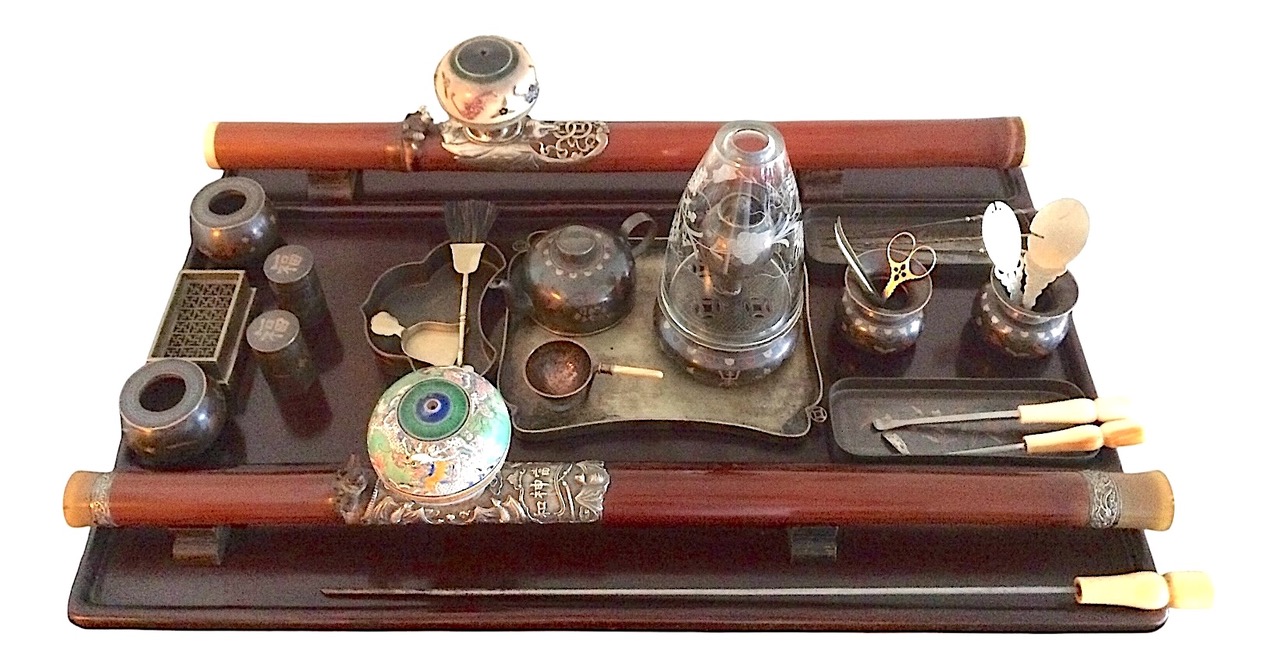
ASIAN OPIUM-SMOKING OBJECTS
Return to Experts
- The expert’s positioning – For Pascal Mergez, the expert’s role goes beyond a simple financial valuation. It consists in understanding each piece, restoring its cultural and symbolic context, and enabling it to "tell its story".
- Experience and resources used – For the past 15 years, he has built a database listing most opium-related objects that have passed through auction rooms internationally, including results and the corresponding photographs. This database is complemented by a reference library providing the documentation required for authentication, also supported by several years of Chinese study. He collaborates with a network of specialists—linguists, historians and technicians—to validate translations of ancient texts or to explore certain technical or contextual points in greater depth.
- Definition of authenticity – An object is deemed authentic if it was designed and made for a use consistent with its original function. Conversely, objects initially intended for other uses—such as tea trays or calligrapher’s accessories—may, through functional repurposing, become genuine opium-smoking pieces. He pays particular attention to any alterations an object may have undergone. His guiding principle is summed up by the phrase: "Restoration, yes; transformation, no!". The material and aesthetic integrity of the object must be preserved, and any intervention that alters its structure is considered an infringement of its authenticity.
- Traceability and provenance – A piece’s provenance and history are essential criteria in its valuation. An authentic object with verifiable provenance or history has increased value compared with an object lacking such elements. The expert therefore endeavours to gather as much information as possible on the object’s origin, use and transmission, supported by tangible evidence: archives, documents, correspondence, testimonies or sales catalogues. These principles systematically guide his research and structure the analytical approach applied to each piece examined.
Bibliography
A few books in which objects from his collection appear, or in which he is mentioned: - The art of an addiction – Benjamin Rapaport & Carlos Armero - Quadrus Communications – 2005 - The art of opium antiques – Steven Martin - Silkworm Books – 2007 - The Art of Smoked Opium – Laure Brown - Naga Editions – 2005 - Is this still an opium pipe…? – Yves Domzalski - YD – 2025 - The Chinese encounter with opium – K. Flow - SMC Publishing Inc. – 2009 - Collections, collectionneurs – Emmanuel Pierrat & Guillaume de Laubier - Éditions La Martinière – 2019 - The Divine Bamboo – Arnould de Lidekerke - Publications Nuit et Jour – L’Objet d’Art – January 1988 - Opium Memoirs – Dominique and Éric Delalande- Somogy Editions d’Art – 2011 - The Mystique of Opium – Donald Wigal- Parkstone International – 2004
Contact
Pascal MERGEZ
+33 (0) 6 24 56 51 75
pascal.mergez@gmail.com
[UFE number : 514]