
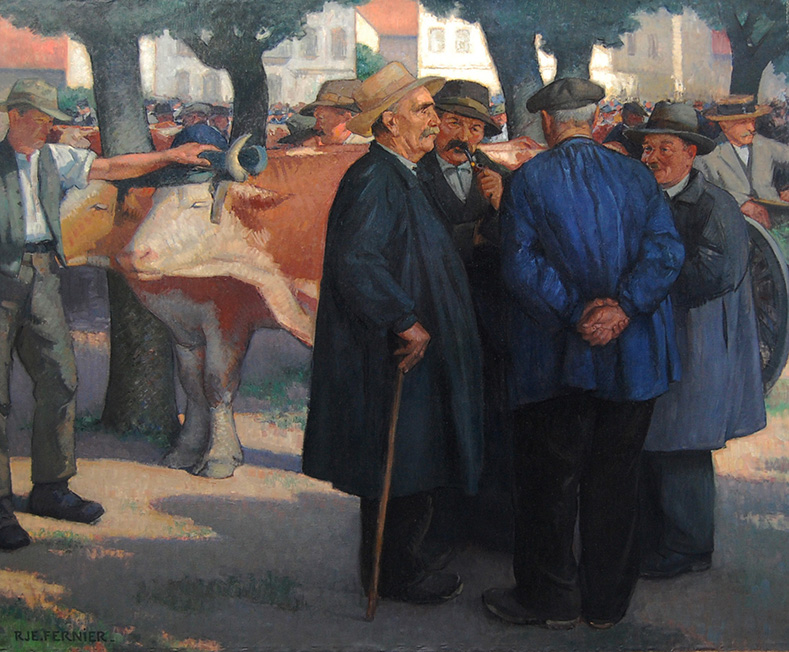
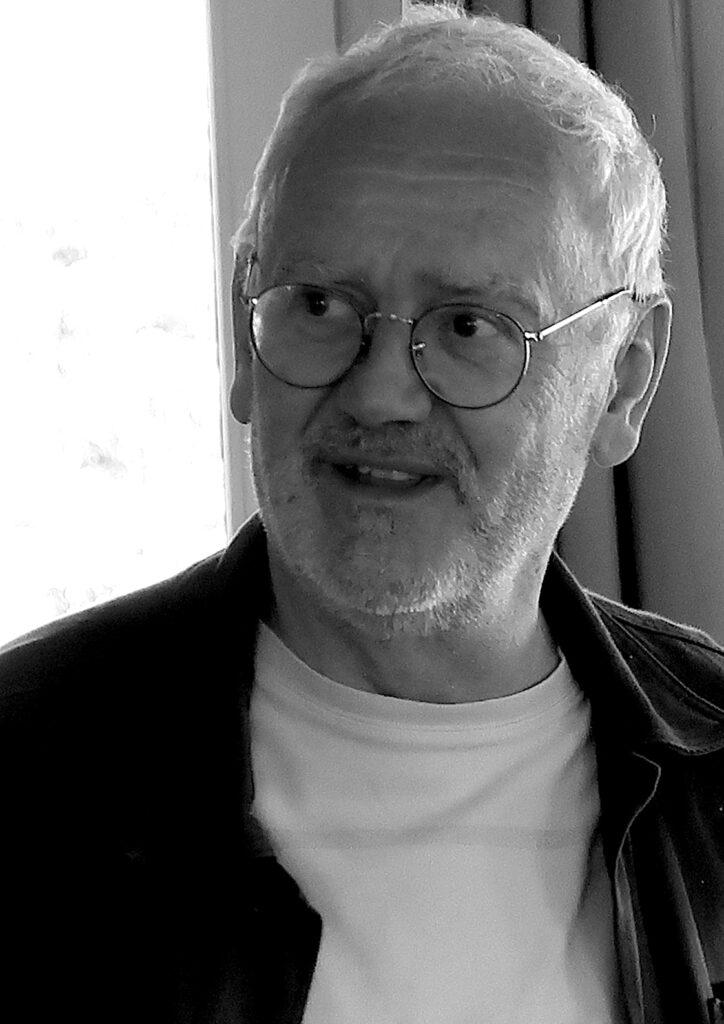
Brice Leibundgut, 2022. © Brice Leibundgut.
5 QUESTIONS for Brice Leibundgut, specialist in Franche-Comté painters
A native of Doubs and an engineer from École Centrale de Paris, Brice Leibundgut is a historian of Franche-Comté, whose history he explores, recounts, and analyzes through his works, presentations, and conferences, covering literature – he is president of the Association des Amis de Louis Pergaud –, industry – he is a descendant of a line of watchmakers – and Art.
A member of the Bureau of the Robert Fernier Association, treasurer of the Société de l’Histoire de l’Art français, and a member of the board of directors of the Gustave Courbet Institute, Brice Leibundgut joined the UFE to specifically represent three Franche-Comté painters: Robert Fernier, Dagnan-Bouveret, and Gustave Courtois.
– How do you define your area of expertise? Why did you choose these three artists?
Brice Leibundgut. I first became interested in Robert Fernier, who extensively depicted the mountains of Haut-Doubs, my home region, in his paintings, as well as the traditions of this area, often with an ethnographic approach. I then extended my expertise to Robert Fernier’s two masters, Gustave Courtois and Dagnan-Bouveret, who were students of Jean-Léon Gérôme. Gérôme is one of the two reference painters of Franche-Comté, along with Gustave Courbet, whom Robert Fernier knew perfectly, having established Gustave Courbet’s Catalogue Raisonné and also being instrumental in the creation of the Gustave Courbet Museum in Ornans.
– What, in your opinion, are the qualities of a good expert?
- B. L. A good expert must have a solid documentary foundation. First, one must know the art historical references for the artist, the places, and the period concerned. Furthermore, for the expertise of a painter, it is almost necessary to undertake the creation or updating of a catalogue raisonné. Also, the establishment of an artist’s biography or at least a detailed chronology is crucial. One must be able to place a work both within a painting trajectory and a life journey. Moreover, a good expert must have developed their own approach, certainly allowing for intuition and emotion, but above all for systematic analysis according to a detailed framework. I would add that a good expert must have doubts. They capitalize on their errors, which allows them to strengthen their knowledge of the artist.
– What is the specificity of the expertise of the painters you have chosen?
- B. L. The three artists for whom I am an expert are figurative painters who worked at the end of the 19th century and in the first half of the 20th century. There is a certain geographical unity among these painters, a strong connection to Franche-Comté, and also a lineage. Robert Fernier was a student of Courtois and Dagnan-Bouveret. Furthermore, Robert Fernier managed to unite a group of colleagues around him: sometimes referred to as the École des Annonciades, named after the salon they created in the Annonciades chapel in Pontarlier. These three painters worked extensively for about fifty years each: they needed to make a living from their painting and, for that, to constantly renew themselves.
– What are the main difficulties you encounter?
- B. L. One of the main difficulties is accessing archives. For Robert Fernier, his descendants preserve numerous documents and have deposited some of them at the Municipal Archives of Pontarlier. For Dagnan-Bouveret, there is a very rich collection at the Departmental Archives of Haute-Saône. However, very few documents are available concerning Gustave Courtois, except within the Dagnan-Bouveret collection. But a documentary corpus is not enough. It is also necessary to organize the information and make it usable: it is often by preparing conferences or symposia that I advance in my knowledge of these artists and structure my approach.
– What do you expect from the UFE?
- B. L. First, that it offers us tools to share: this is already the case with, for example, the insurance contract negotiated for members. We could also collectively consider technical means, such as comparative studies on software for managing a Catalogue Raisonné. Beyond that, I hope that the UFE will be a place for discussion – an expert is sometimes alone with their questions – and a place for exchanging best practices. The CEDEA, which the UFE has joined, could also help broaden this circle of exchanges.
Comments collected by the UFE Bureau.
{%CAPTION%}