
Five questions
for Philippe Koutouzis
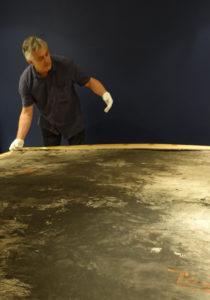
Philippe Koutouzis appraising a work by T’ang Haywen (1927-1991) at Sotheby’s Hong Kong in 2015 © T’ang Haywen Archives
In your view, what are the qualities of a good expert?
P.K. Equipped with his knowledge of the work and, if necessary, constantly evolving scientific methods, he must adopt an objective approach and learn to distinguish truth from plausibility. He must be an honest and pragmatic judge of the work presented to him and avoid any conflicts of interest.
What is unique about the expertise required for T’ang Haywen?
P.K. It stems from the specific nature of the work. To provide some context: first of all, T’ang had a classical Chinese and Taoist approach to pictorial production, combining spontaneity with a search for harmony that is not always achieved.
Furthermore, the work is unique in its formats. T’ang painted the majority of his work in ink, watercolor, and wash in diptych or triptych formats, as well as standard formats, which is unique in the entire history of art.
An important aspect of his expertise is the classification and dating of the works, painted on identified cardboard or paper, which can sometimes be dated. T’ang was very prolific and almost never curated his own works. Like all Chinese calligraphers or painters in traditional media, he accumulated his production without really selecting. His works are not all signed; sometimes they are only signed on the back, but when a signature exists, it is often an integral part of the composition.
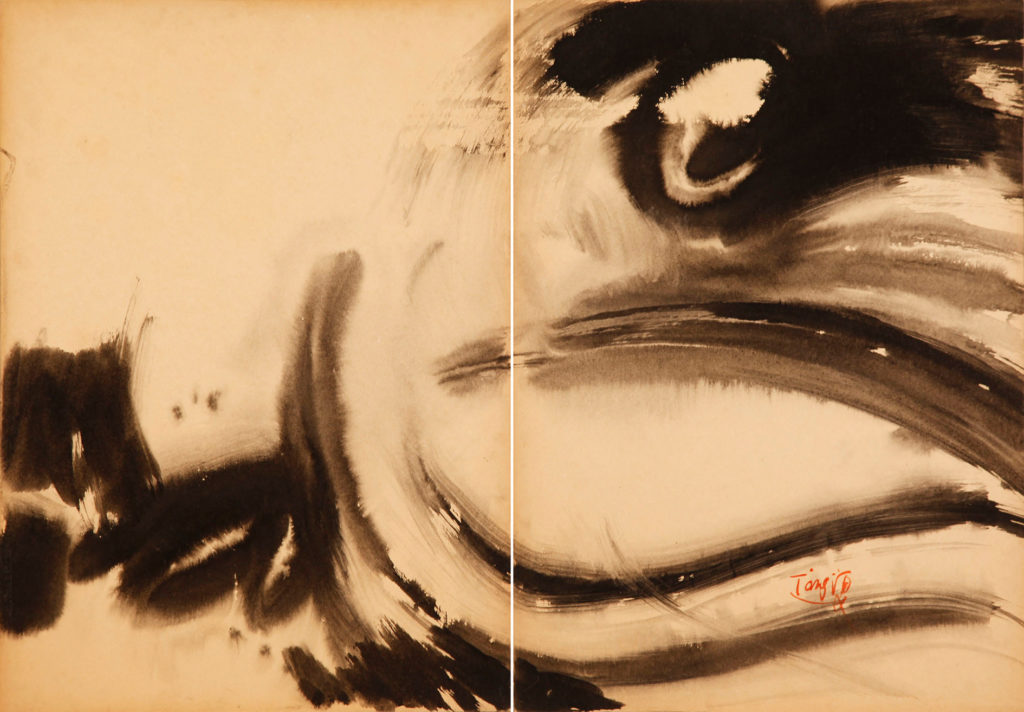
T’ang Haywen (1927-1991) – Birth of the Dragon 1970 – Ink, diptych on Kyro cardboard, 70x100cm – Collection of the M+ Museum, Hong Kong, China. © T’ang Haywen Archives. Exhibited at the Musée des Beaux-Arts de Quimper in 1983, the Musée du Château de Vitré in 1984, and then at the Centre Georges Pompidou in 1989.
What are the main difficulties an expert faces?
P.K. The primary mission of the expert is to distinguish the authentic from the fake.
In recent years, the buoyant market for modern Asian art has motivated forgers and unscrupulous or reckless dealers. This mission has been made more difficult for me by successive legal challenges I have faced. While these have certainly slowed my efforts to promote the work, they have also served to publicly confirm the objectivity of my position regarding it. On February 28, 2018, the Court of Cassation clearly confirmed my rights and ended eight years of groundless lawsuits. In 2015, during a conversation, Suzi Villiger, my colleague from the CRSA in New York and an expert on the work of Joan Mitchell, told me, “You know Philippe, being the editor of a Catalogue Raisonné is a thankless task, but someone has to do it.”
Indeed, the expert is at the service of the work.
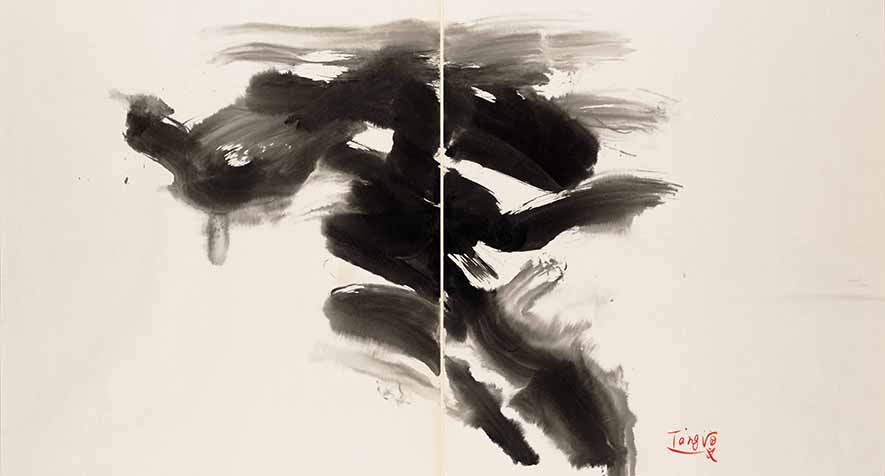
T’ang Haywen (1927-1991) – Untitled [detail] c. 1970 – Ink, diptych on Kyro cardboard, 70x100cm, Private Coll. © T’ang Haywen Archives
An expert’s skills, initiatives, or legitimacy may be challenged by third parties. This can take a very confrontational form, sometimes leading to legal action. Based on your experience, how should an expert protect and defend themselves when necessary?
Any challenges, whatever they may be, must be reasoned, but the interests at stake can lead to legal action that may become inevitable; it doesn’t just happen to others.
The first means of prevention available to the expert, alongside their knowledge of the work, is the adoption of a code of ethics and a methodology to which they adhere in the exercise of their expertise. They provide their opinion, justify it, and may sometimes be mistaken, but it is up to the challenger to prove their claims before any legal debate, unless the latter has decided to manipulate the justice system.
The second means of defense is being able to call upon fellow experts who share the same principles and who can assist before a trial begins or during a trial if necessary.
The third, if targeted by legal action, is to have a good lawyer with whom they will share all information and for whom they will become an assistant in preparing their defense.
If they are professional, intellectually honest, consistent, and clear in their communication, the expert should be able to avoid most of these pitfalls by facing challenges to their expertise with calm and determination.
What do you expect from the UFE?
P.K. Meeting and exchanging information with other experts who adhere to the same principles.
The propagation and maintenance of these principles, typical of our French expertise, in order to guarantee true confidence from collectors to institutions.
Interview conducted by Hervé Labrid, UFE Secretary General, and Sylvie Buisson, UFE President © D.R. Philippe Koutouzis and the UFE / interview published in French and Chinese in the Asia Dossier of the journal SURRÉALISMUS No. 8 SUMMER/AUTUMN 2021 under the title “The Expert at Work”