
Raphaël ROUX DIT BUISSON
JACQUELINE MARVAL, HER LIFE, HER WORK

Return to Experts
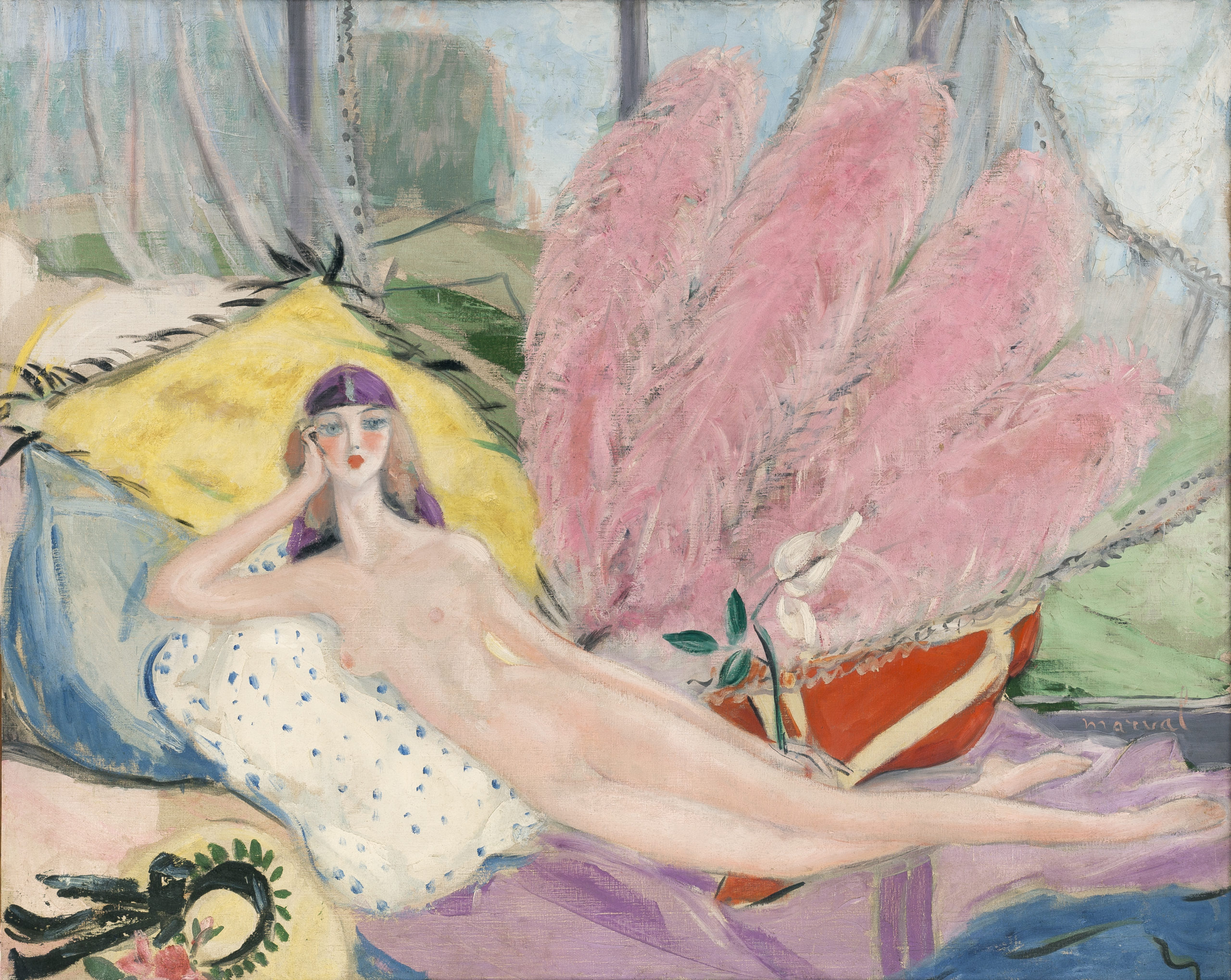
Jacqueline Marval L’Etrange Femme, 1920. 130 x 162 cm. Collection Raphaël Roux dit Buisson, Paris.
Jacqueline Marval - The Strange Woman, 1920. 130 x 162 cm. Collection Raphaël Roux dit Buisson, Paris. © Archives of the Catalogue Raisonné of Jacqueline Marval's Work
The Expert Art is a catalyst for encounters: arriving in Paris from Grenoble, Raphaël Roux dit Buisson, who, unknowingly, followed the same geographical path as the artist Jacqueline Marval, to whose work he would later dedicate a large part of his research and activity, first experienced African sculpture in Paris. It was in this field of Primitive Art that he first made his mark in Paris and embarked on a career as an art dealer. Familiar with the many materials used in Primitive Art, he discovered, through his contact with it, a particular sensitivity to the intelligence of forms and Modernity. This approach is reminiscent of the paramount importance of African and Oceanian masks and sculptures, and their revolutionary influence on Western Art through André Derain, Henri Matisse, Pablo Picasso, Amedeo Modigliani, Fernand Léger, brilliant discoverers,... as well as Guillaume Apollinaire or Blaise Cendrars, the poets, in the early years of the 20th century. It is logical that Raphaël Roux dit Buisson's activity shifted towards Modern and Avant-Garde Painting, of which he is now a specialist, particularly from the post-neoclassical period to the 1960s. Initially established near the Hôtel Drouot, he built a loyal clientele of art enthusiasts, then in 1990, he opened the Galerie Thomire at the Louvre des Antiquaires, specializing in 19th and 20th-century painting, where Jacqueline Marval's works were regularly featured. Raphaël Roux dit Buisson advised collectors there for 25 years. His activity continues today, through a lighter structure, and is largely dedicated to promoting a better understanding of Jacqueline Marval's work and that of her era. Putting his skills and connections at the service of his contacts, he promotes collections by advising them, in particular, on lending some of their works to international exhibitions.   The artist Jacqueline MARVAL (Quaix-en-Chartreuse, Isère 1866 - 1932 at Broussais Hospital, Paris) Born near Grenoble in 1866, the eldest of eight children in a family of teachers, she pursued studies without conviction that destined her for teaching. She married, and the painful loss of her first child brought about a decisive turning point. Alone and subsisting on small waistcoat-making jobs, she moved to Paris around 1895 to 9, rue Campagne-Première in Montparnasse, among the greatest artists. She thus entered the world of painting through the main door, and her companion, the painter Jules Flandrin (1871-1947), a student of Gustave Moreau at the Beaux-Arts de Paris, promptly introduced her to Marquet, Matisse, Manguin, Rouault, Camoin, and Guérin, among others. Imbued with the ambitions of Fauvist painting, the young artist blossomed at the center of a world of talented men; her most expressive admirers included Apollinaire and André-Farcy. Although her works were rejected at the Salon des Indépendants in 1900 – like many of her colleagues – in 1901, she exhibited there for the first time. Berthe Weill, Ambroise Vollard, and then Eugène Druet took an interest in her. After the historic exhibition in February 1902, where the paintings of Matisse, Marquet, Flandrin, and Marval were presented for the first time in a private setting by Berthe Weill, in her small gallery at 25, rue Victor-Massé in Paris, a long pictorial activity marked by numerous exhibitions in Paris, Europe, the United States, and Asia began for Marval. With unfailing kindness towards her friends and many young artists whom she helped unstintingly, Marval was praised by Parisian critics who highlighted the singularity and modernity of her painting. From her beautiful countryside at 19, Quai Saint-Michel in Paris, in the company of her prestigious neighbors, with windows wide open onto Notre-Dame Cathedral, she continued her work in a dream world with the certainty that characterizes the artist. Her friends Matisse, Picasso, Apollinaire, and many others were struck by the power of her great innovative painting: "Les Odalisques," presented at the Salon des Indépendants in 1903 (1), and now preserved at the Musée des Beaux-Arts de Grenoble. Of a comparable, but inverted, format and a composition similar to Pablo Picasso's Demoiselles d'Avignon, one is entitled to wonder if "Les Odalisques," which Marval created between 1902 and 1903, was not one of the sources that inspired Pablo Picasso in 1907. She died in poverty in Paris on May 28, 1932, in the same hospital room as another magician of French art: Paul Verlaine. Without descendants, her work was dispersed after the closure of the Druet gallery in 1938. Marval's work gradually sank into a long silence. While Marval's exceptional journey depicts her prominent role in Paris at the beginning of the 20th century, Raphaël Roux dit Buisson's work is indeed to revive, through exhibitions and publications, the great History to which the young woman from Isère, who became the most Parisian of Parisians and a leading female artist of Modernity, is intimately connected. (1)- Matisse's remarks during a visit to the studio of painter Lucien Mainssieux (1885-1958) and reported in the latter's manuscripts preserved at the Musée Mainssieux de Voiron [caption id="attachment_3164" align="alignleft" width="300"]Women of Art Dec. 2020 © Comité Marval, Paris Women of Art - Dec. 2021 © Comité Marval, Paris [/caption]

Bibliography

Raphaël Roux dit Buisson, and his daughter Camille Roux dit Buisson, inaugurated the Jacqueline Marval Committee in early 2020, headquartered at 4 cité Malesherbes, Paris 9th. A selection of highly representative works by the artist, as well as archives and numerous publications, are presented there and can be consulted by appointment. Many events take place there, particularly in relation to the media outlet Femmes d'Art (@femmesdart_ on Instagram) - link to listen: https://open.spotify.com/episode/3RYQbDpCzhpI3GEahJ1JhB?si=3a0988a1f5574866 The Catalogue Raisonné of Jacqueline Marval's Work, currently in preparation under the direction of Raphaël and Camille Roux dit Buisson, will allow for an exhaustive classification and inventory of a very important body of work, dispersed in museums and major collections worldwide. The website https://www.jacqueline-marval.com provides information about this artist and the procedures for authenticating and cataloging works with the Marval Committee in Paris.
Instagram https://www.instagram.com/comitejacquelinemarval/  

Contact

Raphaël ROUX DIT BUISSON
Jacqueline Marval Committee 15, boulevard Delessert 75016 Paris +33 (0)6 07 26 63 46 comite@jacqueline-marval.com www.jacqueline-marval.com www.dulacfineart.com

[UFE number : 270]
UFE Raphaël ROUX DIT BUISSON