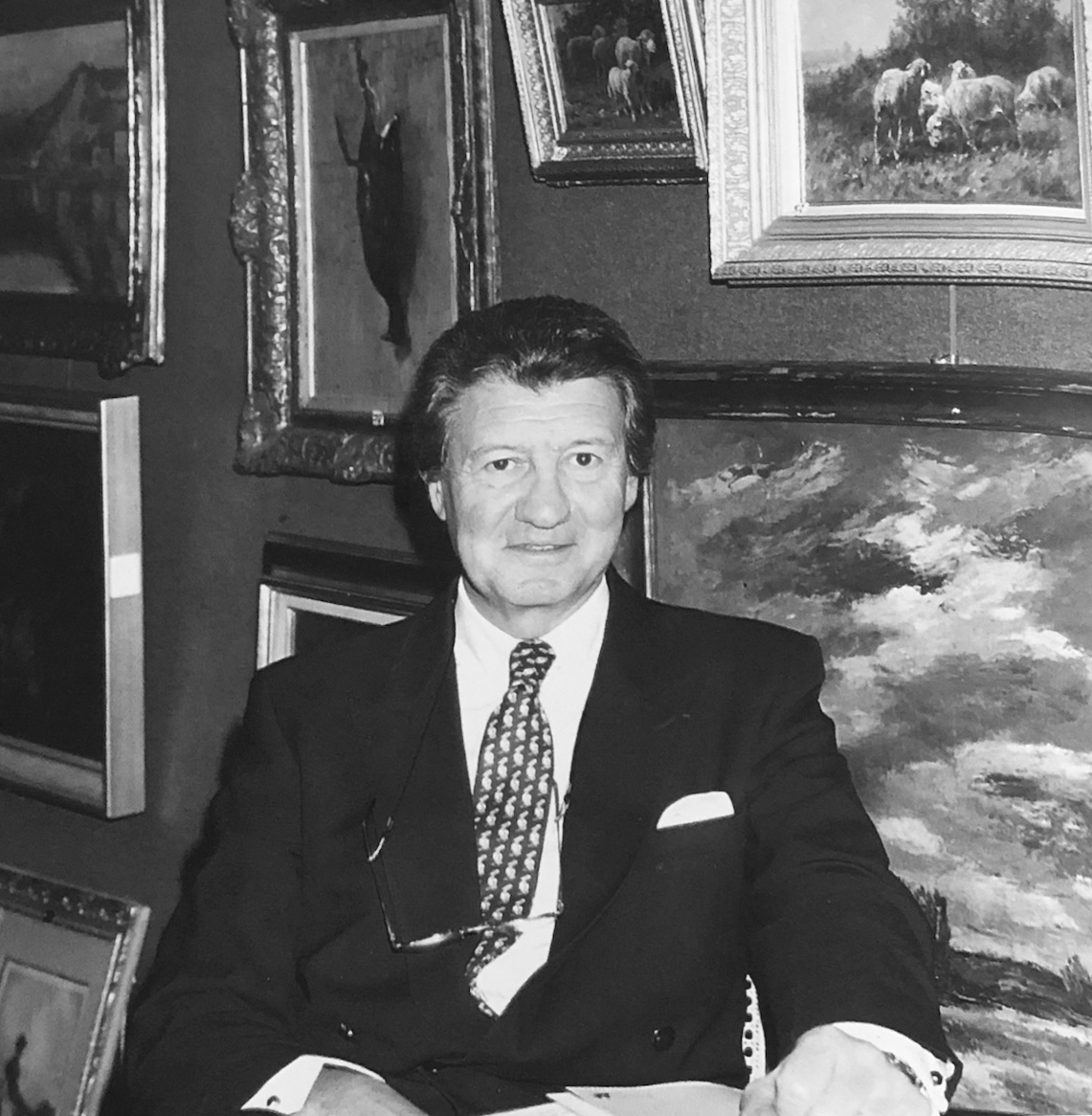
Michel RODRIGUE * honorary member
PRE-IMPRESSIONIST PAINTING - BARBIZON SCHOOL - JULES NOËL AND HIS WORK
Return to Experts

Victor Dupré, Les grands chênes à Barbizon, Oil on canvas, (detail) Private collection. © Michel Rodrigue, Paris
Concise Art History, the sentiment of Nature.
As early as 1812, Napoleon I personally wished to renew Art in France. Regarding painting, in order to move away from the classicism of Ingres and David, he instituted by decree a new category in the Beaux-Arts competitions and Prix de Rome, titled 'Portraits of Trees,' following the advice of painters Camille Corot, Théodore Caruelle d'Aligny, and Jean-Victor Bertin. Consequently, first by carriages, then later by railways, Parisian artists left their studios and the forests near Paris, especially Meudon, to travel from 1820 onwards to the small villages of Chailly-en-Bière, Bourron-Marlotte, and Barbizon near Fontainebleau, where it was easy to settle, eat, and sleep at the Ganne inn. The Fontainebleau forest became their domain and refuge; far from the suffocating urbanism of the capital, this forest offered painters a kind of wild nature in miniature. There, driven by the sentiment of nature, artists fascinated by the landscape, trees, and forest animals, would be faithfully present in the Barbizon area for more than half a century, dedicated to rural motifs of renewed accuracy and bucolic charm; their works would be successfully exhibited by the Petit and Durand Ruel galleries. In the painting salons in Paris, they would be considered innovators. Nature finally entered the Beaux-Arts and the Salons through the main door, stripped of historical or mythological subjects. Camille Flers, Théodore Rousseau, Charles Jacque, Antoine-Louis Barye, Jacques-Raymond Brascassat, Louis-Nicolas Cabat, Camille Corot, Charles-François Daubigny, Honoré Daumier, Narcisse Diaz de la Pena, Léon-Victor Dupré, Paul Huet, Jean-François Millet, Charles-Olivier de Penne, Constant Troyon, Félix Ziem, Ferdinand Chaigneau, Eugène Lavieille, Hippolyte-Camille Delpy… and Jules Dupré became indispensable, attracting young and future Impressionists to Barbizon. Claude Monet, Édouard Manet, Edgar Degas, or Auguste Renoir would go to Barbizon to “do Diaz,” as they put it. It is undeniable that Barbizon painting was one of the sources of inspiration for many painters, and particularly for the Impressionists in the second half of the 19th century. The expert Michel Rodrigue has, to date, viewed over 30,000 works from the Barbizon School, 15,000 of which have been presented in public sales. Since 2022, Michel Rodrigue has become an honorary, but still active, member of the UFE.Bibliography
- Michel Rodrigue and André Cariou, “Jules Noël,” Éditions Palantines, Quimper 2005 -“L’Oise, de Dupré à Vlaminck,” Éditions Somogy, Paris 2007 - contributions by Michel Rodrigue https://musee.ville-isle-adam.fr/publication-musee/loise-de-dupre-vlaminck Michel Rodrigue is currently preparing the supplement to the Catalogue raisonné de l'Oeuvre de Jules Dupré
Contact
Michel RODRIGUE * honorary member
37 rue Jouvenet
75016 Paris
+33 (0)6 08 57 19 03
monique.rodrigue@hotmail.fr
[UFE number : 324]