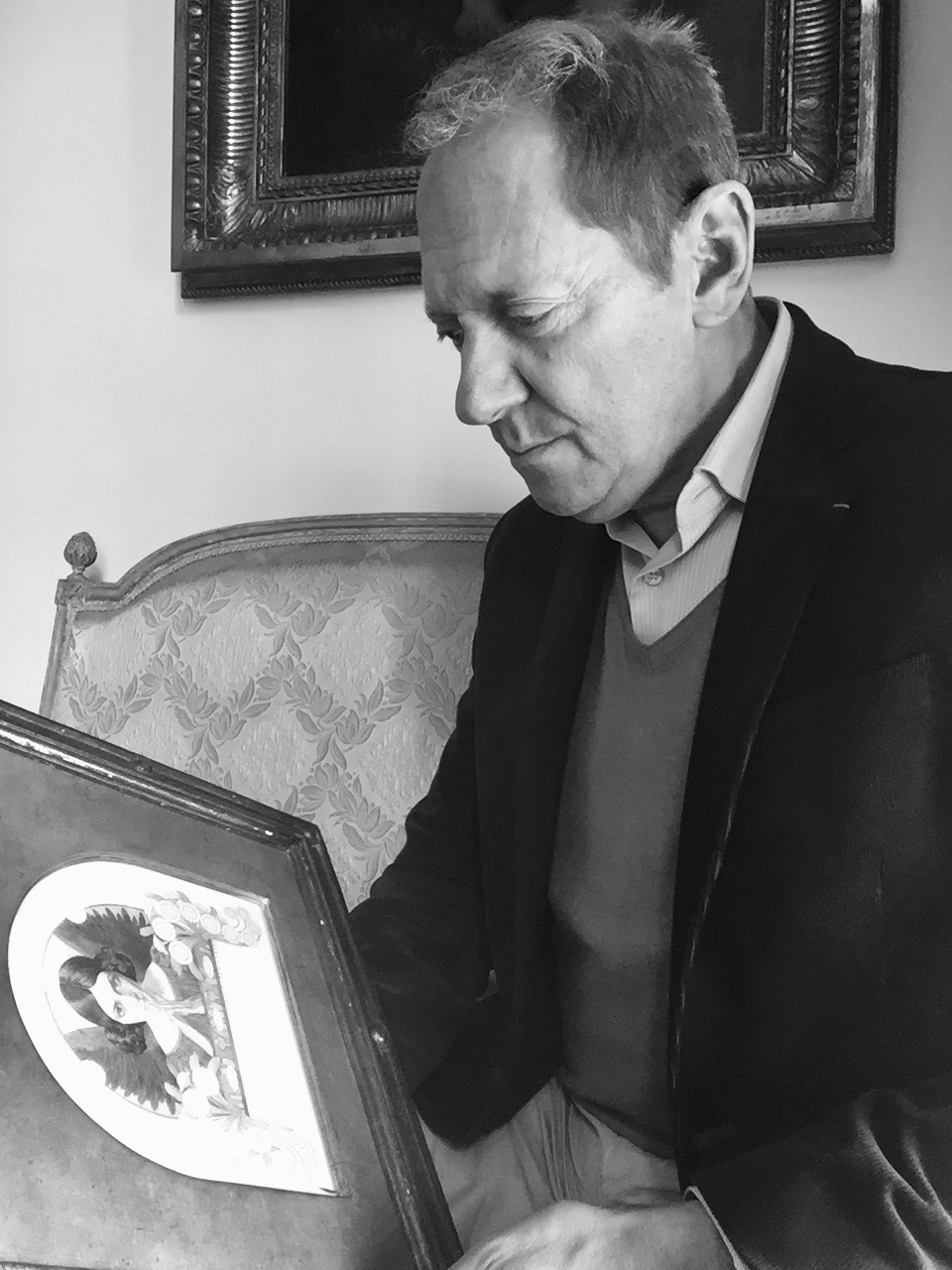
Jean-David JUMEAU-LAFOND
CARLOS SCHWABE (1866-1926), HIS LIFE, HIS WORK, AND SYMBOLIST ART
Return to Experts

The origin of a passion:
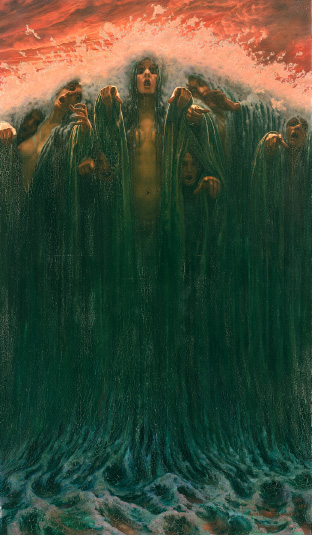
Jean-David Jumeau-Lafond is the great-grandson of the Swiss Symbolist painter and illustrator Carlos Schwabe, through his mother Jacqueline Jumeau-Lafond (1923-2014), daughter of Odette Vary-Schwabe (1893-1980), the second of the artist’s six children. He thus benefited from childhood from Schwabe’s “presence” and from knowledge of the Symbolist era thanks to a very vivid family memory. As no studies were then available on this painter, he began his research at the age of seventeen by visiting the storage rooms of the Musée d’Art et d’Histoire in Geneva: most of the works from Schwabe’s studio were stored there, donated by his family after his death to the city of which he had been a citizen since 1888. Seeing masterpieces such as The Wave and Sorrow, then carelessly stored in a cellar, was the formative shock that became a passion for the artist and his time.The artist:
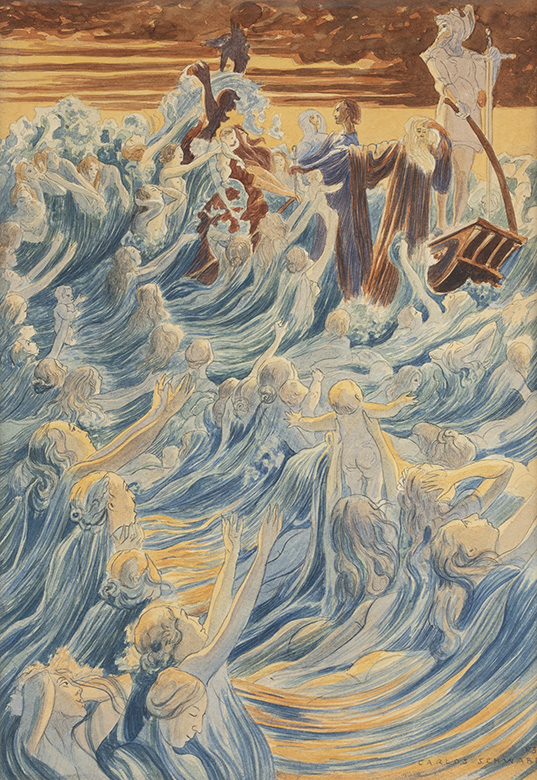
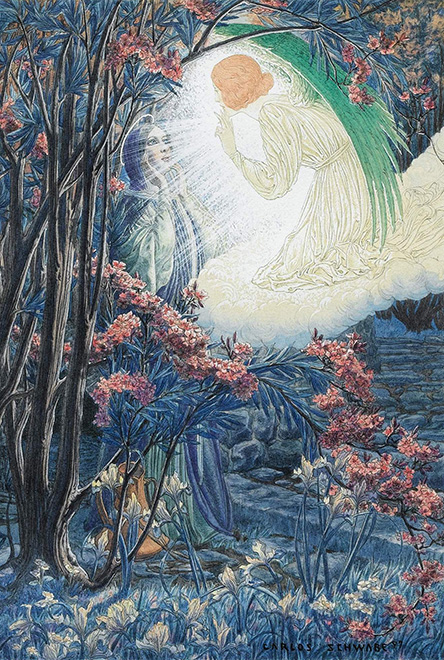
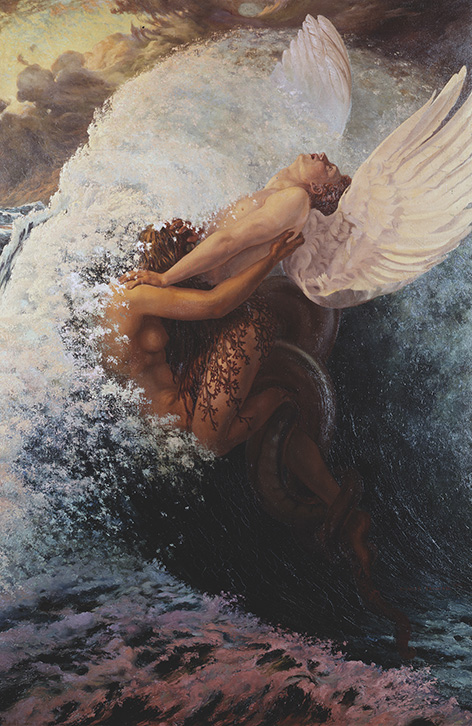
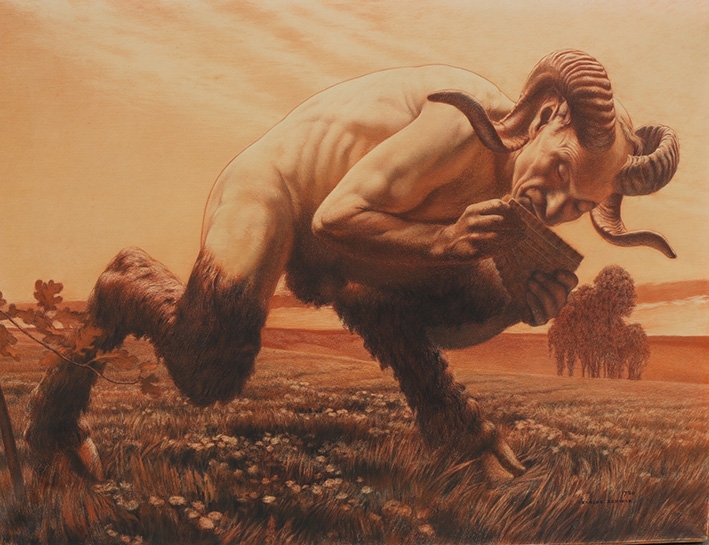
Carlos Schwabe, born in Altona (Hamburg) in 1866 left Germany for Geneva with his family around 1870 and became a Swiss citizen. After studying at the École des Arts industriels in Geneva, he spent most of his life in France, in Paris and in Barbizon. Closely connected to the idealist circles of the fin de siècle (painters, philosophers, musicians), he became one of the most important Symbolist illustrators (Baudelaire, Samain, Haraucourt, Mallarmé, Maeterlinck and Zola’s The Dream, misunderstood by the author...) while also producing large watercolor drawings in which a fin-de-siècle spiritual quest merges with graphic experimentation whose acuity and “primitive” character reminded critics of the art of Dürer or Mantegna. His Death of the Gravedigger (Paris, Musée d’Orsay), his Virgin with Lilies (Amsterdam, Van Gogh Museum) and his Spleen and Ideal (Brussels, Royal Museums of Fine Arts) are among the emblematic images of the Symbolist movement. His conception of art reflects the concerns of a generation troubled by triumphant materialism: art must defend an ideal. Schwabe was also connected to circles of social utopia; close to the founders of the Universités populaires and the Ligue des Droits de l’Homme, he expressed in his drawings the artist’s moral duty toward the world. While pursuing a path that was sometimes less Symbolist and more sensual after the turn of the century, he also produced portraits and landscapes. Yet the final decades of his life are punctuated by works still marked by visionary idealism: The Wave and its three-crayon studies, the two versions of the Faun, Homer, and his melancholic women bearing lyres. To a perfectionist technique, though highly personal and far removed from any academicism, Schwabe added until the end of his life a spiritual gaze and a vision beyond reality.Education, appraisal expertise, and area of specialization:
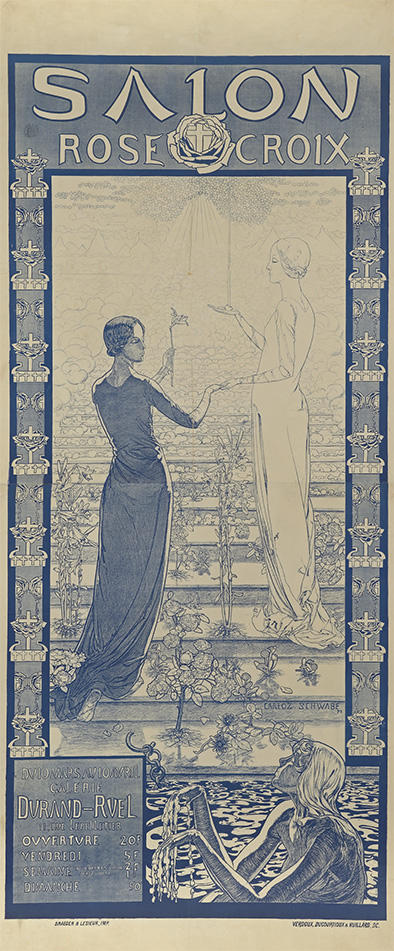
As the logical continuation and guiding thread of his interest in his great-grandfather, Jean-David Jumeau-Lafond pursued his art history studies at the University of Paris I Panthéon-Sorbonne. After nearly eighteen years of research, he defended in 1994 his doctoral thesis: Carlos Schwabe, Symbolist painter, essay and catalogue raisonné of the work. This thesis, awarded the highest honors and the jury’s congratulations, was presented at the University of Clermont-Ferrand II in order to benefit from the supervision of Professor Jean-Paul Bouillon, one of the foremost specialists of the period. Published by ACR the same year as the defense, the book resulting from this work remains the reference work on the subject: Carlos Schwabe, Symbolist and Visionary. Since then, Jean-David Jumeau-Lafond has nonetheless published various articles and supplementary studies on the artist following new reflections and discoveries, continually enriching the catalogue raisonné of the work. His expertise regarding Schwabe’s works—their technique, their highly personal iconography, and the complexity of their signature, which varied over the painter’s lifetime—thus draws on more than forty years of experience. It is complemented by the moral rights he holds as the painter’s descendant. While continuing this work and updating knowledge about the Swiss artist, Jean-David Jumeau-Lafond soon sought to broaden his research to the entire idealist context of the late 19th century and to manifestations of the Symbolist movement, including the relationships between the arts, poetry and music, spiritualism, and the Salons de la Rose+Croix. He has thus published around a hundred scholarly articles, contributed to several dozen exhibition catalogues worldwide (New York, London, Ottawa, Tokyo, Budapest, Madrid, Mexico City, Geneva, etc.), and served as curator for several exhibitions, in addition to various literary anthologies devoted to the “fin de siècle” and numerous critical contributions to La Tribune de l’art. He regularly sits on doctoral juries as a guest specialist. The complete list of his work can be consulted online on his bibliographic website. Among them may be cited Painters of the Soul: Idealist Symbolism in France, available in six languages and accompanying an exhibition presented in various forms in nine countries and thirteen museums from 1999 to 2007, and Alexandre Séon: Ideal Beauty, the first monograph devoted to this student of Puvis de Chavannes, accompanying the exhibition held at the Musée des Beaux-Arts de Quimper and the Musée d’Art moderne et contemporain de Saint-Étienne in 2015. A bibliophile and collector, Jean-David Jumeau-Lafond is deeply attached to the object as much as to the cultural context; he never separates documentary work from direct contact with the works, nor scholarly approach from sensitive perception and knowledge of the period, without which one cannot claim to grasp and understand the artist’s creative process. His area of expertise therefore includes, in addition to Carlos Schwabe, numerous Symbolist artists, including such as Alexandre Séon, Jeanne Jacquemin, Armand Point, Lucien Lévy-Dhurmer and, more generally, French idealists close to the Salons de la Rose+Croix. A member of the Société des Gens de Lettres, the Société de l’Histoire de l’art français and the Syndicat de la presse artistique française, he was appointed Chevalier of the Ordre des Arts et des Lettres in 1996.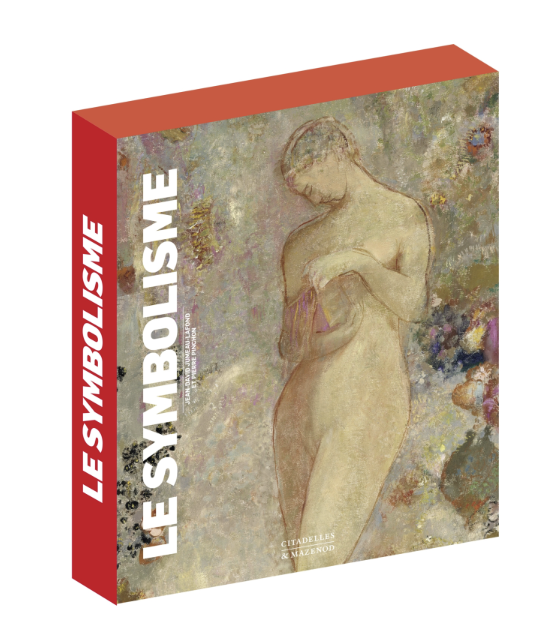


Bibliography
The expert’s complete bibliography can be consulted on his website: www.jeandavidjumeaulafond.com /
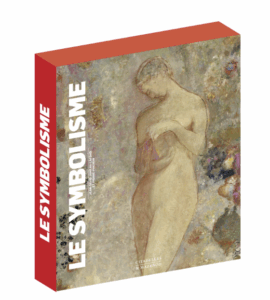
The most recent, published by Éditions Citadelles & Mazenod, in 2025 with Perre Pinchon, with contributions by Rossella Froissart, Laurent Houssais and Adriana Sotropa.
https://citadelles-mazenod.com/product/le-symbolisme/
 In addition to Carlos Schwabe, many Symbolist artists also fall within Jean-David Jumeau-Lafond’s specialization, including
Alexandre Séon,
Jeanne Jacquemin,
Armand Point,
Lucien Lévy-Dhurmer
and, more generally, French idealists close to the Salons de la Rose+Croix.
In addition to Carlos Schwabe, many Symbolist artists also fall within Jean-David Jumeau-Lafond’s specialization, including
Alexandre Séon,
Jeanne Jacquemin,
Armand Point,
Lucien Lévy-Dhurmer
and, more generally, French idealists close to the Salons de la Rose+Croix.
Contact
Jean-David JUMEAU-LAFOND
+33 (0)6 09 67 67 74
jdjumeaulafond@wanadoo.fr
www.jeandavidjumeaulafond.com
[UFE number : 398]