Casimir BUISSON
LÉONARD FOUJITA (1886-1968), HIS LIFE, HIS WORK
Return to Experts
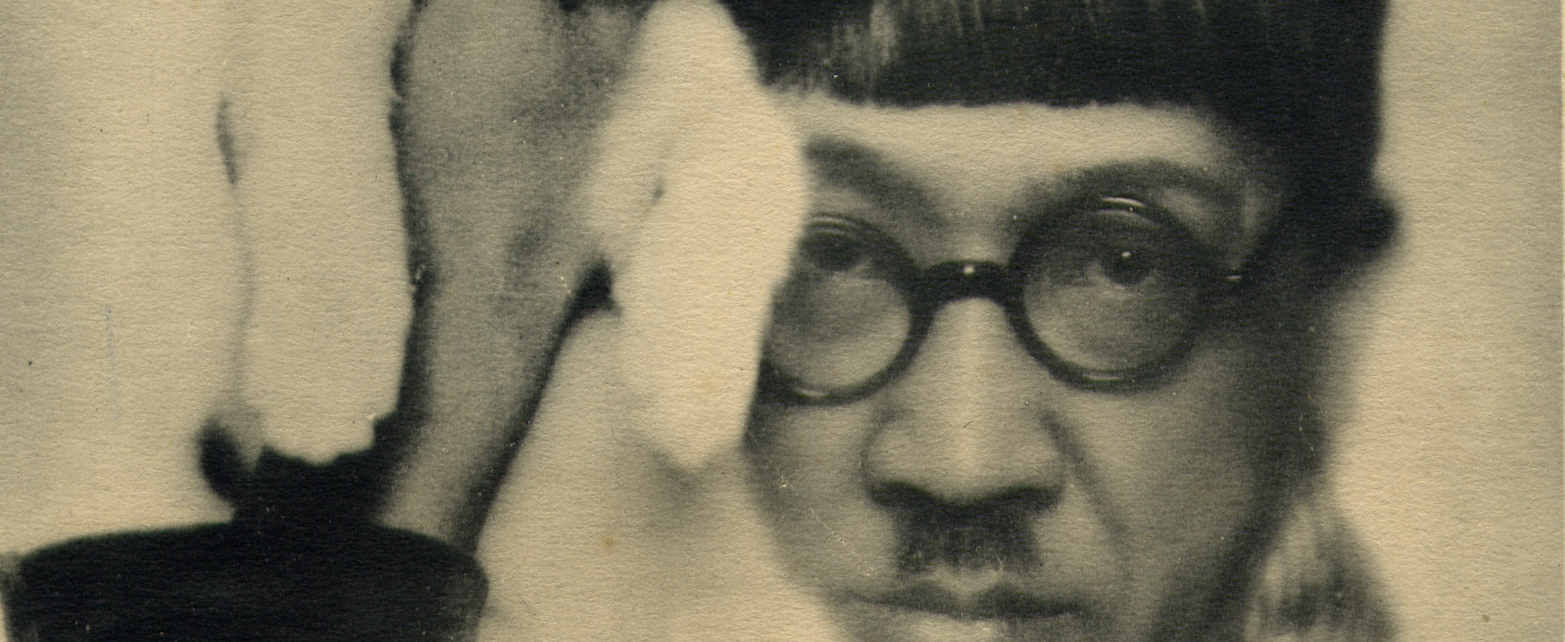
[detail] 1927 – iconic photograph by Dora Kallmus (1881-1963) – Tsuguharu-Léonard Foujita (1886-1968), his round tortoiseshell glasses, his famous fringe, his cat Boutchi © private archives.
The Artist
Tsuguharu-Léonard Foujita, Avant-Garde Painter.
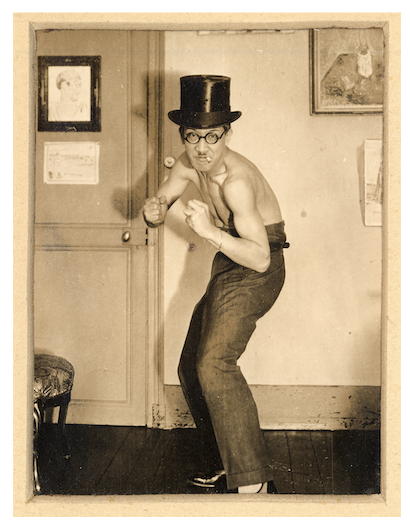
1923, Foujita in his studio on rue Delambre, photograph from a private collection.
He is the modern Japanese painter who established himself within the School of Paris during the great period of the 1920s and 1930s, when Paris was considered the undisputed capital of the arts worldwide.
Alongside Picasso, Matisse, Modigliani, Vlaminck, Derain, Soutine, Chagall, Kisling, Marie Laurencin… and many other French and foreign artists whose aim was to revisit the very image and spirit of Painting by modernizing it, Foujita established himself as the most French of Japanese painters during this blessed period. Each of the artists of the School of Paris [a term coined by art critic André Warnod in 1923 in a famous manifesto article in the newspaper Comoedia] used, in complete freedom, their own technical means, their own vision of the world, their own culture, feeling carried by the overall emulation of this multicultural Parisian terrain.
Foujita therefore contributed with his friends to “dusting off” figurative modes of representation not only by refining them but above all by creating a fusion still unique of its kind within the avant-gardes of the 20th century, between the culture of the East and that of the West, between the cultures of origin (Western, Asian, and primitive) and the primarily Russian and French avant-gardes.
Foujita therefore dared to build a bridge between Japan, his native country, and France, his adopted country.
Erudite in both his own native culture and in Western arts and techniques, Foujita endeavored to favor none while appropriating them, installing them together within each of his representations: drawings, paintings, engravings, and many other objects of his making.
Never has the term hybridization been more justly employed than with Foujita.
The body of his works is dispersed throughout the world
His oeuvre comprises no fewer than 6,000 major works. The painter was highly prolific in France, North and South America, and Japan.
His expertise requires extensive work and a considerable body of archives.
______________________________________________________________________________________________________________________________
The Expert
Casimir Buisson has shared for 15 years the work of archiving, expertise, and cataloging of Foujita’s works with Sylvie Buisson, who has progressively transmitted to him the extent of her knowledge.
He has also traveled and curated several museum exhibitions of original works by Foujita in Japan and France.
His studies as an art restorer (Painting) between 1996 and 2000 at the Palazzo Spinelli in Florence led him to work within the collections of the museums of that city, notably the Uffizi, under the direction of state restorers.
In Florence, he acquired extensive experience in the techniques of the great Cinquecento masters, from whom Foujita drew inspiration for both technique and form. It is worth noting that he took his baptismal name from Leonardo da Vinci in 1959. Casimir Buisson’s career—in addition to studying numerous works by Foujita submitted for appraisal to his studio—has become essential to current scientific research aimed at specifically identifying Foujita’s pictorial techniques and detecting increasingly sophisticated forgeries.
Foujita’s technique is indeed similar to that of the great masters of the Renaissance (glazing, varnish, composition of the material)
His training as a painting technician, particularly of the pictorial layer, enables Casimir Buisson to establish extremely precise condition reports of works, to assess their conservation, and to prescribe restorations, appropriate framing, and necessary conservation conditions.
Since 2010, Casimir Buisson has accompanied Sylvie Buisson, an expert on the artist Foujita at the Union Française des Experts since 1989, in this demanding work of identifying, numbering, and classifying works, as well as preparing editions of the General Catalogue Raisonné of Foujita’s Work.
He drafts certificates of authenticity with her and, since 2025, has co-signed them, while actively participating in the curation of several exhibitions centered on Foujita’s Work.
Bibliography
NEWS: to be published in June 2026; see the subscription offer on the website www.foujita.org
– Sylvie Buisson, Catalogue of the travelling exhibition “The 7 Passions of Foujita” 2025-2026 / Paramita Museum, Okad Cultural Foundation, in Mie; Sompo Museum of Art, in Tokyo; Koiso Memorial Museum of Art, in Kobe; Kagoshima City Museum of Art; Fukuyama Museum of Art; Fukuyama Museum of Art, Hiroshima; Iwate Museum of Art, Morioka; Sagawa Museum of Art, Moriyama – from 1 February 2024 to 20 November 2026 / Organization: BRAIN-TRUST INC LTD. France-Japan coordination: Momoe Suga. Curatorship: Sylvie BUISSON, with the participation of Casimir BUISSON and Midori YANAI, art historian, former curator of the Meguro Museum, Tokyo.
– Sylvie Buisson and Casimir Buisson / ACRB Editions, Paris with the participation of the Nichido Kasama Museum of Art Foundation, Japan GENERAL CATALOGUE RAISONNÉ OF THE WORK OF TSUGUHARU-LÉONARD FOUJITA, VOLUME 3 AND VOLUME 4 Volume 3 – 224 pages and 528 illustrations of Foujita’s works AND Volume 4 – 644 pages and 942 illustrations of Foujita’s works
Contact
Casimir BUISSON
Paris
+33 (0) 6 59 63 13 28
[UFE number : 463]