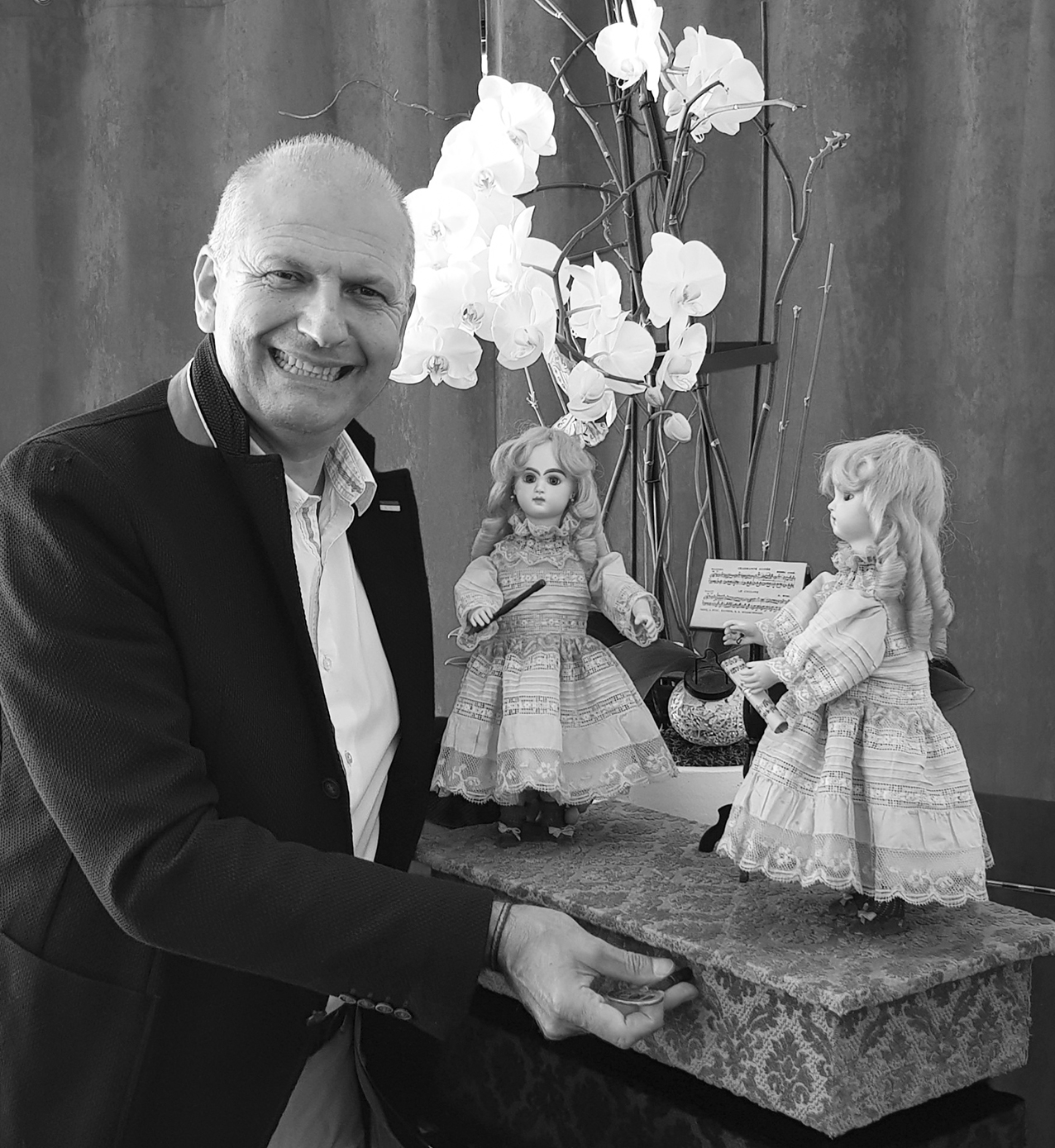
Jean-Marc POULIN
DOLLS AND AUTOMATA - 18TH CENTURY FRENCH FURNITURE
Return to Experts
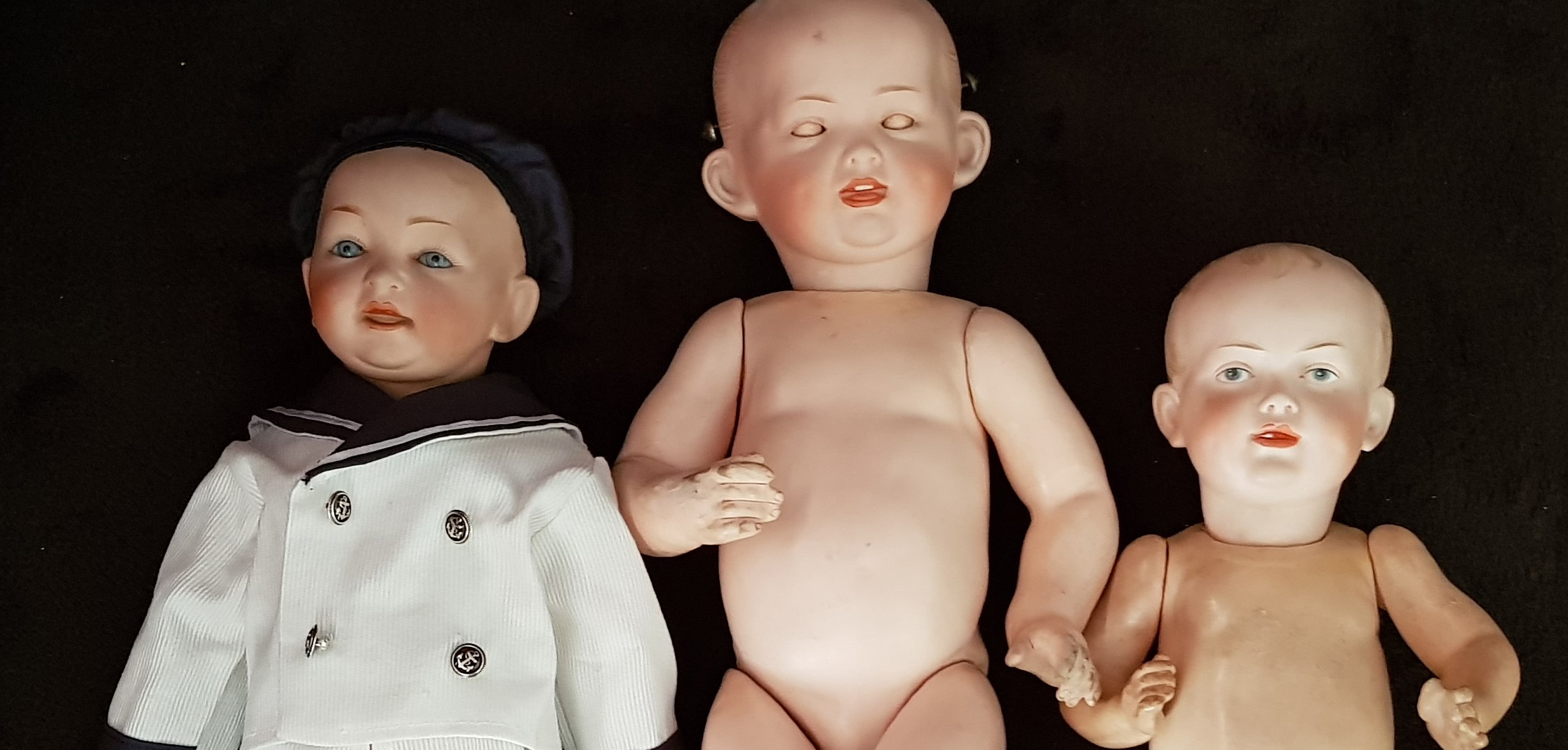
Dolls © Jean-Marc Poulin, © UFE expert, Paris 2020
 The Expert
Dolls and automata
As a young high school graduate, he wished to pursue the profession of antique dealer specializing in these two fields, but the course of his life decided otherwise, and he embraced and practiced the career of pharmacist.
Nevertheless, he never left the world of dolls and automata. From Portobello Market in London to the Balon in Turin, the Doll Museum in Monaco, and all the numerous antique fairs in France and Europe, he remained in constant contact with these objects that fascinate him, both of great beauty and composed of very diverse and complex mechanisms and materials.
Remaining very attentive to market developments, Jean-Marc Poulin travels to auctions, particularly in Chartres, Paris, and Lyon, when rare models appear.
Today, he can finally devote himself entirely to this passion and, as an expert, share his knowledge with informed enthusiasts who wish to complete a collection or more novice buyers who want to acquire a particular model that appeals to them.
His various participations as seller or buyer at the Galerie de Chartres of Maître Jean-Pierre Lelièvre or with the former firm of Maître Madeleine Milliarède, now De Baecque et Associés, have enabled him, combined with regular reading of French, English, or German works, to practice and deepen his knowledge, which he is ready to make available.
18th century French furniture
Furthermore, through his family background, Jean-Marc Poulin has always studied 18th century furniture.
18th century cabinetmaking followed the history of the monarchs of France; it was a discipline characterized by exotic influences from Asia, but also by a very high level of craftsmanship.
From the mid-17th century until the end of the 18th century, each king of France gave his name to the emerging cabinetmaking styles: thus we know Louis XIV (1643-1715), Louis XV (1715-74), and Louis XVI (1774-92) furniture. As Louis XV was only five years old at the death of his great-grandfather, and all other members of the royal family had been decimated by smallpox, the Duke of Orléans assumed the title of regent, giving the period (1715-23) a second designation, "Régence."
At the end of the eighteenth century, the monarchy in France came to an end, and with it, the decorative flourishes of rococo. In 1784, Jacques-Louis David inaugurated the triumphant arrival of classicism with his painting "The Oath of the Horatii." During the French Revolution, which celebrated the ideals of Greek democracy, this trend continued. The following years called "Directoire" (1795-1799) served as a pillar for the formative stylistic devices of classicism.
The Expert
Dolls and automata
As a young high school graduate, he wished to pursue the profession of antique dealer specializing in these two fields, but the course of his life decided otherwise, and he embraced and practiced the career of pharmacist.
Nevertheless, he never left the world of dolls and automata. From Portobello Market in London to the Balon in Turin, the Doll Museum in Monaco, and all the numerous antique fairs in France and Europe, he remained in constant contact with these objects that fascinate him, both of great beauty and composed of very diverse and complex mechanisms and materials.
Remaining very attentive to market developments, Jean-Marc Poulin travels to auctions, particularly in Chartres, Paris, and Lyon, when rare models appear.
Today, he can finally devote himself entirely to this passion and, as an expert, share his knowledge with informed enthusiasts who wish to complete a collection or more novice buyers who want to acquire a particular model that appeals to them.
His various participations as seller or buyer at the Galerie de Chartres of Maître Jean-Pierre Lelièvre or with the former firm of Maître Madeleine Milliarède, now De Baecque et Associés, have enabled him, combined with regular reading of French, English, or German works, to practice and deepen his knowledge, which he is ready to make available.
18th century French furniture
Furthermore, through his family background, Jean-Marc Poulin has always studied 18th century furniture.
18th century cabinetmaking followed the history of the monarchs of France; it was a discipline characterized by exotic influences from Asia, but also by a very high level of craftsmanship.
From the mid-17th century until the end of the 18th century, each king of France gave his name to the emerging cabinetmaking styles: thus we know Louis XIV (1643-1715), Louis XV (1715-74), and Louis XVI (1774-92) furniture. As Louis XV was only five years old at the death of his great-grandfather, and all other members of the royal family had been decimated by smallpox, the Duke of Orléans assumed the title of regent, giving the period (1715-23) a second designation, "Régence."
At the end of the eighteenth century, the monarchy in France came to an end, and with it, the decorative flourishes of rococo. In 1784, Jacques-Louis David inaugurated the triumphant arrival of classicism with his painting "The Oath of the Horatii." During the French Revolution, which celebrated the ideals of Greek democracy, this trend continued. The following years called "Directoire" (1795-1799) served as a pillar for the formative stylistic devices of classicism.
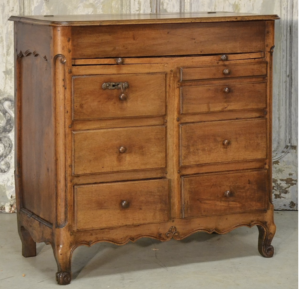
Commode, or trade furniture, in walnut from the Louis XV period. On the front, seven drawers and a pull-out shelf on the upper section. The drop-leaf top is divided into three compartments. Paneled sides and recessed uprights ending in scroll feet.
© Rennes-antiquités, 2022
Bibliography
Various catalogs and journals specialized in the field of expert Jean-Marc Poulin
Contact
Jean-Marc POULIN
Le Calenda
320 avenue de la Mounine
13320 Bouc-Bel-Air
+33 (0)6 70 07 38 31
poulin.jeanmarc13@gmail.com
[UFE number : 474]