
Bertrand Puvis de Chavannes

Five questions for Bertrand Puvis de Chavannes
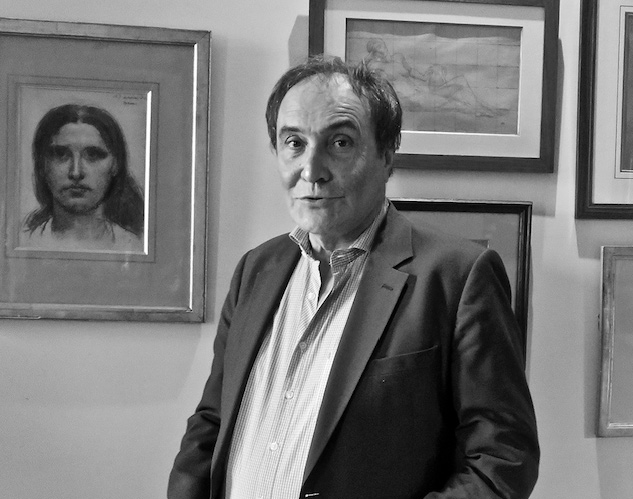
Great-grandnephew of Pierre-Cécile Puvis de Chavannes, a painter from Lyon and a precursor of Symbolism, Bertrand Puvis de Chavannes had been its expert for fifteen years; he joined the UFE in the second half of 2019. We learned of his death in October 2023 following a long illness.
We keep this interview article in our memory, which pays tribute to our late, deeply missed colleague.
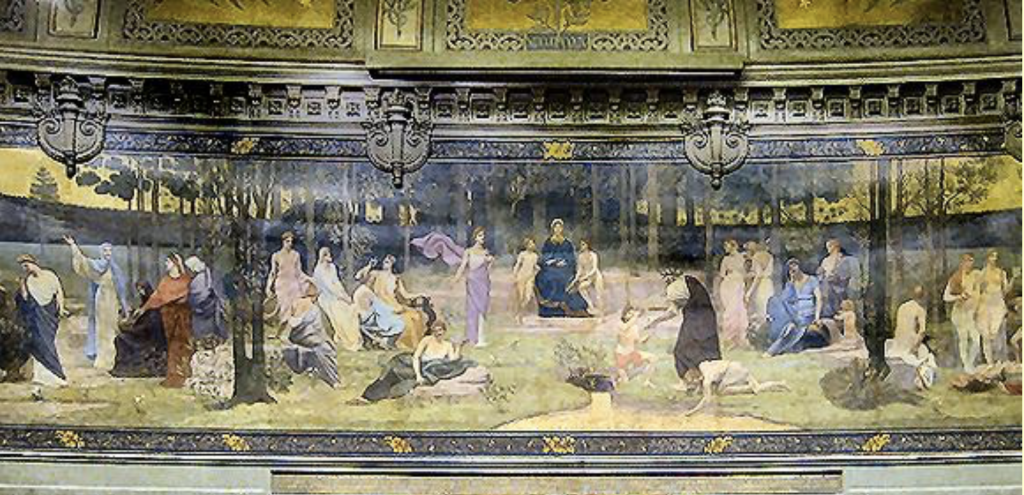
Pierre Puvis de Chavannes – The Sacred Grove – Central part of the allegorical painting completed in 1889 – Grand Amphitheatre of the Sorbonne, Paris © Ufe, Paris
How did you become the expert for Pierre Puvis de Chavannes?
Bertrand Puvis de Chavannes. Since the 1970s, an American academic has undertaken to establish a catalogue raisonné. Her documentation seemed all the more important as she was able to gather information from other researchers, of whom I was already one. The idea was to collaborate in order to produce a catalogue raisonné worthy of the name. However, the requests for information that I or others made were systematically left unanswered. In 1994, this academic curated a Puvis de Chavannes exhibition in Amsterdam, the catalogue of which contained so many inaccuracies that I decided to create the Pierre Puvis de Chavannes Committee, in order to prevent the misunderstandings that a failed catalogue raisonné could cause… These fears were well-founded: for example, when this catalogue was published, Dominique Lobstein kindly emphasized in La Tribune de l’Art the many reservations raised by the author’s choices…
The Puvis de Chavannes Committee represents eighty of the painter’s beneficiaries. Louise d’Argencourt, former curator of the Ottawa Museum, is its vice-president. We have been joined by indisputable connoisseurs of the work such as Serge Lemoine, former president of the Musée d’Orsay, François Blanchetière, curator of the Tours Museum, and Dominique Lobstein, curator of numerous exhibitions.
I am very regularly consulted by heirs, dealers, institutions, generalist experts, auctioneers, and collectors for appraisals or authentications.
In your opinion, what are the qualities of a good expert?
B. P. C. The expert, armed with a very good knowledge of the work, must understand and analyze the artist’s intellectual process, their approach, and their intention. This implies a great familiarity with the era in which they lived, their biography, their tastes, their political choices… But also with their tools and working environment: the type of stretcher or canvas they used, their suppliers… Of course, the expert will be familiar with modern technical means to resort to them when necessary.
What is the specificity of Puvis de Chavannes’ expertise? He produced few works, mainly large-format ones intended for institutions and therefore already known…
B. P. C. He produced a relatively small number of easel paintings, often at the request of Durand-Ruel, his dealer. Most of his time was devoted to large decorations, mostly commissioned by the State, in Paris, Lyon, Marseille, Poitiers, Rouen, and Amiens. These required a lot of preliminary work. There are many sketches and preparatory versions of varying quality… In total, there are now about five hundred paintings. To which must be added thousands of drawings. It is mainly on these works that expertise is exercised, since the painted work is for the most part known.
What are the main difficulties an expert encounters?
B. P. C. They mainly concern the drawings, generally linked to the large decorations. To authenticate them, if the line seems to be that of the painter, it is often necessary to be able to link them to one or another of Puvis’s paintings, even when they have only a distant relationship with the final work. They must also be related to other drawings to identify common or similar details. This requires a lot of experience and the building of good documentation. I have already archived and indexed about 3,500 drawings…
A very beautiful drawing can reach 80,000 to 100,000 euros… Unfortunately, there is a significant number of forgeries in circulation. About one in two of those presented to me. It is not very difficult to deceive amateurs who are unfamiliar with the work with 19th-century drawings renamed “Puvis de Chavannes”. There are also fake stamps… Often, I identify these forgeries from the photograph. For others, I must examine them. The fact that I am consulted by experts and auctioneers prevents these forgeries from going to public auction. If I am consulted after a sale, then yes, it complicates the buyer’s life!
What do you expect from the UFE?
B. P. C. When you practice a profession like ours, exchanges and meetings with other professionals are always enriching. It is an opportunity to compare experiences and different approaches. Since in France experts can also be dealers, they have a second approach, notably because they also aim to increase the artist’s market value. Finally, I hope that my presence within the UFE will help make the existence of the Pierre Puvis de Chavannes Committee better known and give me the opportunity to discover unpublished works!