
THE ART OF JEWELRY, FINE JEWELRY, AND PRECIOUS STONES
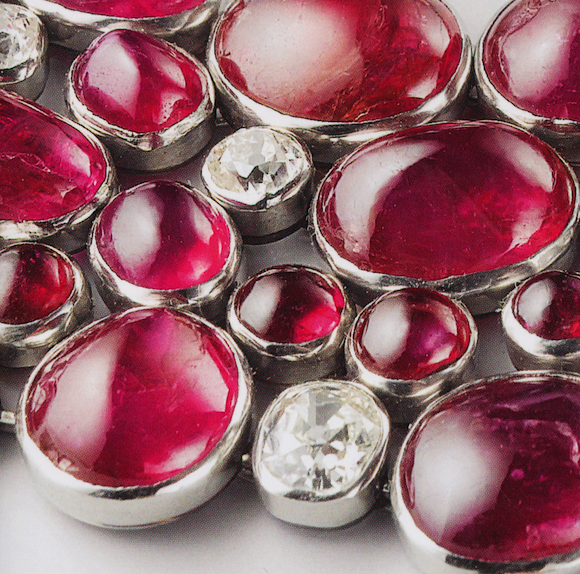
© UFE, Paris / The Art of Jewelry, Fine Jewelry, and Precious Stones; illustration by expert Olivier Baroin - Necklace signed Suzanne Belperron
Learn More
The art of creating adornments dates back to ancient times: jewelry, whether precious or not, brilliantly embellishes those who wear precious metals and fine and ornamental stones, particularly fine pearls of various orientations.
A jewel is always set with at least one precious stone on gold, silver, or platinum: its rarity, exquisite craftsmanship, history, and renown rank it among the masterpieces of great museums. Jewelry, on the other hand, only features semi-precious stones, and its metal is not necessarily precious. Both jewelry and jewels have long symbolized political and religious power.
In France, modern fine jewelry began in the 17th century with new techniques, notably from Italy, which influenced the form and manner of wearing jewelry. Cardinal Mazarin had the most beautiful diamonds of his time set: the sixteen-facet cut has retained his name, it is the Mazarin cut.
The emergence of mass production at the end of the 19th century with the industrial revolution made products previously considered too luxurious accessible. From 1900 onwards, a real change was observed: in the wake of Art Nouveau, designers highlighted artisanal jewelry, and creation took precedence over preciousness.
In Europe, during the First World War, when gold was required for the war effort, jewelry was made from simple metals such as iron and copper; they were no less creative and historical.
Art Deco, heir to Art Nouveau, stimulated greater stylization in fashion and jewelry design in the mid-1920s. New materials like Bakelite and nickel silver were used, while others, such as pewter, were brought back into vogue. Jewelry made with non-precious materials gained a special place; it had its own forms and colors. Coco Chanel and Elsa Schiaparelli offered costume jewelry to accompany their haute-couture dress collections.
Pylons, ball bearings, engines… are some of the astonishing specimens of Art Deco jewelry, whose history is marked by the birth in 1929 of the Union des artistes modernes, which challenged established rules of fine jewelry. Their geometric effects evoke the painted or drawn works of Pablo Picasso, François Kupka, Fernand Léger, Sonia Delaunay, or Kazimir Malevich.
Cartier's rigid ring in 1930, and later, at Van Cleef & Arpels, the Pylons gold and sapphire ring from 1939, or after the war in 1945, the Cartier yellow and red gold bracelet, are examples of this modernity.
Designer Suzanne Belperron, co-director of the Boivin house and right-hand woman to Paul Poiret's sister, was an exception in this landscape constrained by the Art Deco form: her taste for roundness and curves distinguished her from all others and placed her at the forefront of the Avant-gardes. Her creations were purchased and collected by discerning connoisseurs such as the Duchess of Windsor and, more recently, Karl Lagerfeld.
Since the mid-20th century, three sectors have been distinguished in this field:
-Fine jewelry, consisting of unique pieces or limited series made from prestigious materials, sometimes signed by great artists from Alexander Calder to Jeff Koons, including Salvador Dali, Max Ernst, Pablo Picasso, Georges Braque, Niki de Saint Phalle, César, Takis, and Louise Bourgeois.
-Costume jewelry, which includes pieces produced in unlimited series and using, for example, plastic materials.
-Finally, artisanal jewelry, which produces unique pieces or limited series made from a wide variety of often non-precious materials.
The world of jewelry, fine jewelry, and precious stones is so vast, and such high market values are attached to it, that the precise opinion and control of experts must not be overlooked; on the contrary, they are essential before and during any transaction and insurance.
Discover Our experts
BAROIN Olivier
JEWELRY BY SUZANNE BELPERRON (1900-1983)
BAUER-PETIET Pascale
GEMMOLOGY, JEWELRY, FINE JEWELRY OF THE 19TH AND 20TH CENTURIES
RÉA Romain
WRISTWATCHES AND HOROLOGY
MOUNIER Sophie
JEWELRY, JEWELS, GEMSTONES AND DISPLAY OBJECTS FROM THE 18TH CENTURY TO THE PRESENT DAY
GOTTARDINI Didier
COLLECTOR WATCHES AND MASONIC OBJECTS
FRANCIS-BOEUF Alexis
HOROLOGY AND COLLECTIBLE WATCHES
Philippine DUPRÉ LA TOUR
NATURAL PEARLS AND JEWELRY