

Genuine Tortoiseshell
The most beautiful and rarest tortoiseshells come from the Eretmochelys Imbricata, or hawksbill turtle – commonly known as caret – found in the warm waters of the Caribbean. Today, fashion magazines refer to tortoiseshell as a shade of plastic. Genuine tortoiseshell remains coveted by a select few connoisseurs. Tortoiseshell is an ancestral material that has always stimulated human imagination. Virgil, Ovid, and Juvenal already described furniture inlaid with tortoiseshell, and in his satirical work "Dialogues of the Gods," Lucian of Samosata recounts Apollo telling Vulcan how Mercury invented a lyre from tortoiseshell. A large number of Western Polynesian peoples used it for body decorations or on symbolic objects of power. Asia was also a major consumer of boxes and canes decorated with tortoiseshell from China, which were preserved in the Shoso-in treasury as early as the 8th century, during the Nara period. Canton then became the main center for manufacturing tortoiseshell objects. In Japan, the first workshop to use this material was founded in Nagasaki at the end of the 16th century. From the extraordinary cradle of Henry IV, fashioned from an entire shell, to the most beautiful furniture of 18th-century cabinetmaking, and even to tortoiseshell combs, glasses, and cigarette holders of the 19th and 20th centuries, it can be found everywhere, in Europe as in Asia, marquetry-inlaid, fused, or molded, to the great delight of enthusiasts. Tortoiseshell is a noble and living material, natural yet sophisticated, rich in infinite reflections ranging from dark brown to blonde, sometimes reaching honey tones that give it the transparency of glass. It owes its reputation as much to its aesthetic qualities as to its multiple transformation possibilities, which allowed it to be used in decorative art as well as for everyday objects. In Europe, it was the great Portuguese navigators who first introduced marine tortoiseshell in the 16th century. Ferdinand Cortez was one of the first to mention it. The raw material introduced then had to be reinvented and mastered by the artisans of the time. This required thirty to fifty years of research and refinement to achieve the perfect mastery of the 17th century, a period when tortoiseshell became a highly sought-after product. Furniture evolved, and around 1625, heavy solid oak sideboards began to give way to the flamboyant lacquer cabinets that merchants brought back from India, or to ebony and tortoiseshell decoration, exotic products highly prized by the nobility. This complex work with new materials demanded entirely new expertise. In France, it seems that Marie de' Medici initiated the taste for ebony furniture, and specialists in this craft took the name of ébénistes (cabinetmakers), first mentioned in Paris in 1638. Germany and England experienced the same craze, and Louis XIV's France saw the zenith of tortoiseshell, particularly thanks to the cabinetmaker Charles André Boulle (1642-1732). He developed and perfected marquetry veneering in France, a technique already used by the Florentines since the early 16th century. This technique gave rise to some of the most beautiful masterpieces of furniture art. Consoles, desks, tables, cartels, caskets, and cabinets then flourished. The 19th-century discovery of its self-grafting possibilities, allowing for solid work, considerably expanded its scope of application. It could then be fused, turned, sculpted, and shaped, enabling tortoiseshell artisans to create true lacework. The fashion for long hair made this new application of tortoiseshell particularly opportune and allowed for the creation of all sorts of adornments, such as combs, barrettes, and brushes, which were very commonly made of tortoiseshell until the 1960s. Wealthy pre-war Spanish women came to Paris to buy immense combs (up to 60 cm) for their mantillas, sculpted and openwork like true goldsmithery. These objects were sold in "Articles de Paris" stores, at hatters, and in a few specialized boutiques. The extreme lightness of tortoiseshell makes it the preferred product for spectacle makers. A tortoiseshell spectacle frame weighs no more than 16g, does not slip, and is completely hypoallergenic. Its anti-static qualities also allow for the manufacture of combs that are still highly sought after by hairdressers. The most beautiful travel cases, commissioned by prestigious clients, were then made either of ivory or tortoiseshell and personalized individually with the client's initials inlaid in gold in the tortoiseshell. These exceptional commissions, which required months of work, ceased at the time of World War II.Franck and Christian Bonnet, Paris 2021.
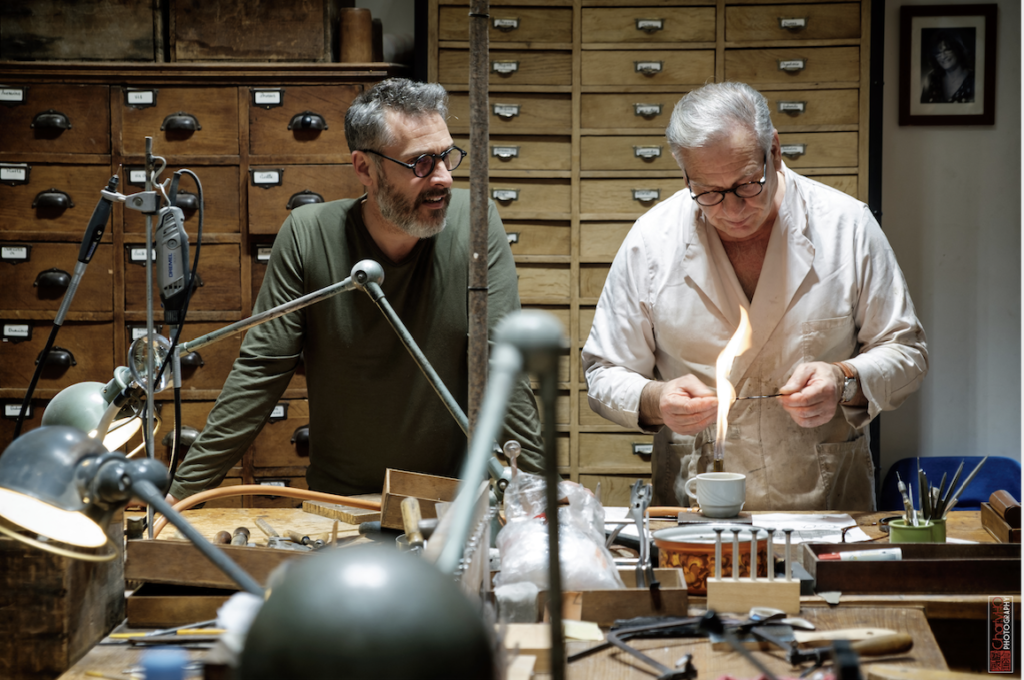 The tortoiseshell artisans, who numbered nearly 200 at the beginning of the century, can now be counted on the fingers of one hand.