
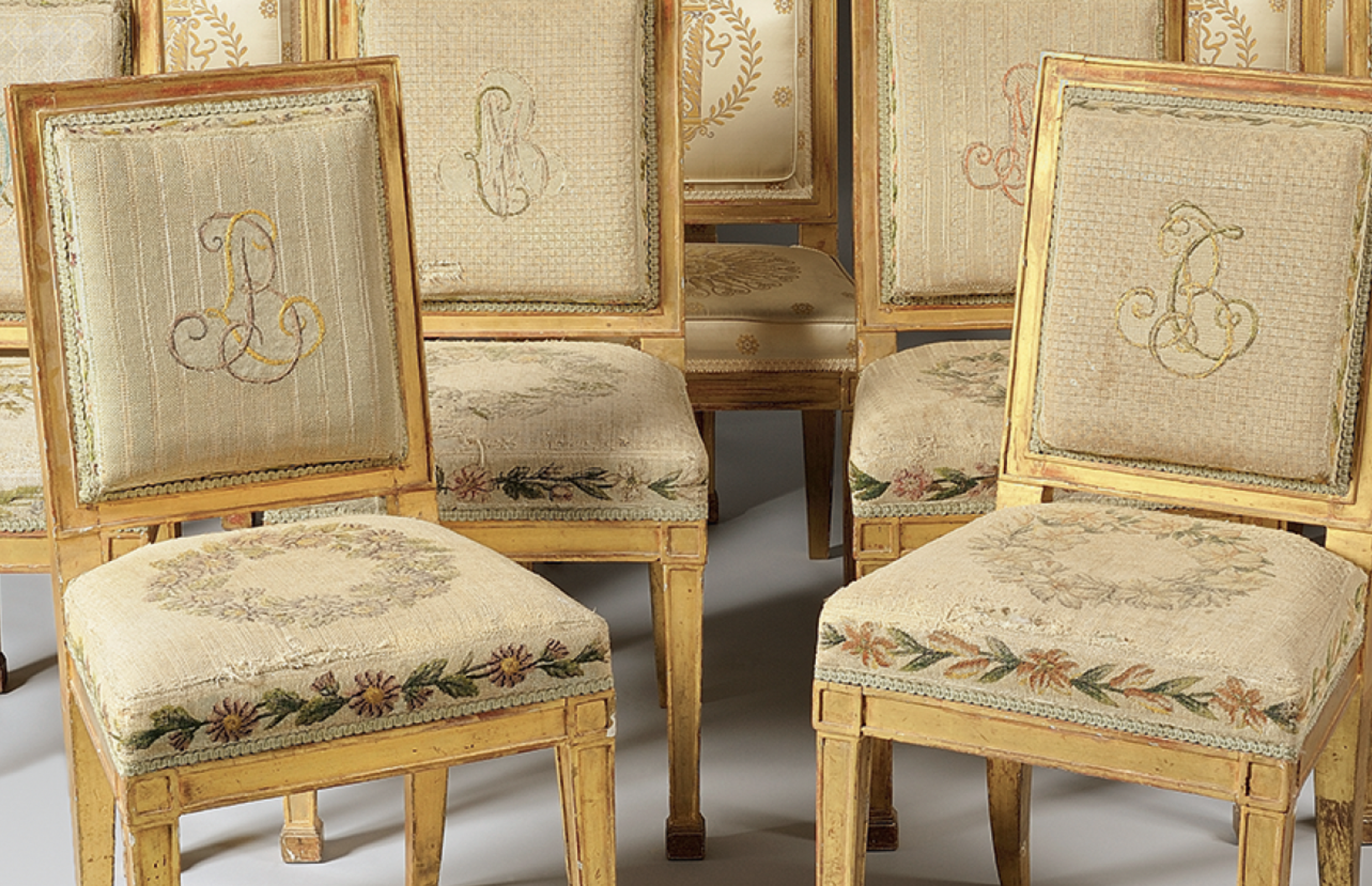
Louis XVI furniture marked the definitive abandonment of rocaille in favor of neoclassicism. The few curves that persisted in Transition furniture were now removed. Louis XVI furniture features rectangular shapes. Following the discoveries of the buried cities of Pompeii and Herculaneum, neoclassical fashion reinterpreted the ornamental vocabulary. Veneer woods, especially mahogany, were the flagship species of the style.
The most common motifs include musical instruments, geometric shapes, pearls, and ribbon knots. To these were added new bronze motifs: fluted plaques and caryatids with female busts. The marble top remained a classic feature of Louis XVI furniture. Sèvres porcelain plaques, the demi-lune commode, the bonheur du jour, and the cabriolet backrest also appeared.
From the end of the Ancien Régime, 19th-century furniture inherited the neoclassical style for about ten years. It abandoned the opulence and exuberant ornamentation of the previous century. These pieces adopted straighter lines and more sober decorations. The 19th century was gradually marked by the industrialization of manufacturing methods, which gave furniture a simplified, yet very elegant design.
The wood used was still mahogany, solid or veneered, as well as walnut, cherry, and beech. Some pieces were made of lacquered and gilded wood. Marquetry played on contrasts with light and dark wood veneers. Among the furniture created during the 19th century, we can mention the psyché, the somno, the barbière, the guéridon, the lit bateau, the chiffonnier, the liqueur cabinet, and the jardinière.